Showing posts with label WORLD WONDERS. Show all posts

Sunday, December 12, 2010

WORLD WONDERS


Chichen Itza  from Yucatec Maya is a large pre-Columbian archaeological site built by the Maya civilization located in the northern center of the Yucatán Peninsula, in the Yucatán state, present-day Mexico.
Chichen Itza was a major focal point in the northern Maya lowlands from the Late Classicthrough the Terminal Classic and into the early portion of the Early Postclassic period. The site exhibits a multitude of architectural styles, from what is called “Mexicanized” and reminiscent of styles seen in central Mexico to the Puuc style found among the Puuc Maya of the northern lowlands. The presence of central Mexican styles was once thought to have been representative of direct migration or even conquest from central Mexico, but most contemporary interpretations view the presence of these non-Maya styles more as the result of cultural diffusion.
The ruins of Chichen Itza are federal property, and the site’s stewardship is maintained by Mexico’s Instituto Nacional de Antropología e Historia (National Institute of Anthropology and History, INAH). The land under the monuments had been privately-owned until March 29, 2010, when it was purchased by the state of Yucatan.
The Maya name "Chich'en Itza" means "At the mouth of the well of the Itza." This derives fromchi', meaning "mouth" or "edge", and ch'e'en, meaning "well." Itzá is the name of an ethnic-lineage group that gained political and economic dominance of the northern peninsula. The name is believed to derive from the Maya itz, meaning "magic," and (h)á, meaning "water." Itzá in Spanish is often translated as "Brujas del Agua (Witches of Water)" but a more precise translation would be Magicians of Water.
The name is often represented as Chichén Itzá in Spanish and when translated into other languages from Spanish to show that both parts of the name are stressed on their final syllables. Other references prefer to employ a more rigorous orthography in which the word is written according to the Maya language, using Chich'en Itzá (pronounced [tʃitʃʼen itsáʔ]). This form preserves the phonemic distinction between ch' and ch, since the base word ch'e'en (which, however, does have a neutral tone vowel "e" in Maya and is not accented or stressed in Maya) begins with a glottalized affricate. The word "Itzá'" has a high rise final "a" that is followed by a glottal stop (indicated by the apostrophe).
There is evidence in the Chilam Balam books that there was another, earlier name for this city prior to the arrival of the Itza hegemony in northern Yucatán. This name is difficult to define because of the absence of a single standard of orthography, but it is represented variously as Uuc Yabnal, Uuc Hab Nal,or Uc Abnal.While most sources agree the first word means seven, there is considerable debate as to the correct translation of the rest. Among the translations suggested are “Seven Bushes,” “Seven Great Houses,” or “Seven Lines of Abnal.”Northern Yucatán is arid, and the rivers in the interior all run underground. There are two large, natural sink holes, called cenotes, that could have provided plentiful water year round at Chichen, making it attractive for settlement. Of the two cenotes, the "Cenote Sagrado" or Sacred Cenote(also variously known as the Sacred Well or Well of Sacrifice), is the most famous. According to post-Conquest sources (Maya and Spanish), pre-Columbian Maya sacrificed objects and human beings into the cenote as a form of worship to the Maya rain god Chaac. Edward Herbert Thompson dredged the Cenote Sagrado from 1904 to 1910, and recovered artifacts of gold, jade,pottery, and incense, as well as human remains. A recent study of human remains taken from the Cenote Sagrado found that they had wounds consistent with human sacrifice


.

WORLD WONDERS

Christ the Redeemer  is a statue of Jesus Christ in Rio de Janeiro, Brazil; considered the second largest Art Deco statue in the world. The statue is 39.6 metres (130 ft) tall, including its 9.5 meter (31 feet) pedestal, and 30 metres (98 ft) wide. It weighs 635 tonnes (700 short tons), and is located at the peak of the 700-metre (2,300 ft) Corcovado mountain in the Tijuca Forest National Park overlooking the city. A symbol of Christianity, the statue has become an icon of Rio and Brazil. It is made of reinforced concrete and soapstone, and was constructed between 1922 and 1931.The idea for erecting a large statue atopCorcovado was first suggested in the mid-1850s, when Catholic priest Pedro Maria Boss requested financing from Princess Isabel to build a large religious monument. Princess Isabel did not think much of the idea and it was dismissed in 1889, when Brazil became a republic with laws mandating the separation of church and state.The second proposal for a landmark statue on the mountain was made in 1921 by the Catholic Circle of Rio.The group organised an event calledSemana do Monumento ("Monument Week") to attract donations and collect signatures to support the building of the statue. The donations came mostly from Brazilian Catholics.The designs considered for the "Statue of the Christ" included a representation of the Christian cross, a statue of Jesus with an globe in his hands, and a pedestal symbolizing the world.The statue of Christ the Redeemer with open arms was chosen.It is a symbol of peace as well. There are small spikes on top of the statue in order to prevent birds from resting on it.Local engineer Heitor da Silva Costa designed the statue; it was sculpted by Frenchsculptor Paul Landowski.A group of engineers and technicians studied Landowski's submissions and the decision was made to build the structure out ofreinforced concrete (designed by Albert Caquot) instead of steel, more suitable for the cross-shaped statue.The outer layers are soapstone, chosen for its enduring qualities and ease of use.Construction took nine years, from 1922 to 1931 and cost the equivalent of US$250,000 (approximately US$3.5 million in 2009). The monument was opened on October 12, 1931.The statue was meant to be lit by a battery of floodlights triggered remotely by shortwave radio pioneer Guglielmo Marconi, stationed 5,700 miles (9,200 km) away in Rome, but poor weather affected the signal and it had to be lit by workers in Rio.

In October 2006, on the statue's 75th anniversary, Archbishop of Rio CardinalEusebio Oscar Scheid consecrated a chapel (named after the patron saint of Brazil—Nossa Senhora Aparecida, or Our Lady of the Apparition,") under the statue. This allows Catholics to hold baptisms and weddings there.
The statue was struck by lightning during a violent electrical storm on Sunday, February 10, 2008 and suffered some damage on the fingers, head and eyebrows. A restoration effort was put in place by the Rio de Janeiro state government and archdiocese, to replace some of the outer soapstone layers and repair the lightning rods installed on the statue.On April 15, 2010 graffiti was sprayed on the statue's head and right arm. Mayor Eduardo Paes called the act "a crime against the nation" and vowed to jail the vandals, even offering a reward of R$ 10,000 on any information that may lead to an arrest. The Military Policeeventually identified house painter Paulo Souza dos Santos as the suspect of the act of vandalismOn 7 July 2007, Christ the Redeemer was named one of the New Seven Wonders of the World in a list compiled by the Swiss-based The New Open World Corporation.Leading corporate sponsors, including Banco Bradesco and Rede Globo, had lobbied to have the statue voted into the top seven.


Saturday, December 11, 2010

WORLD WONDERS

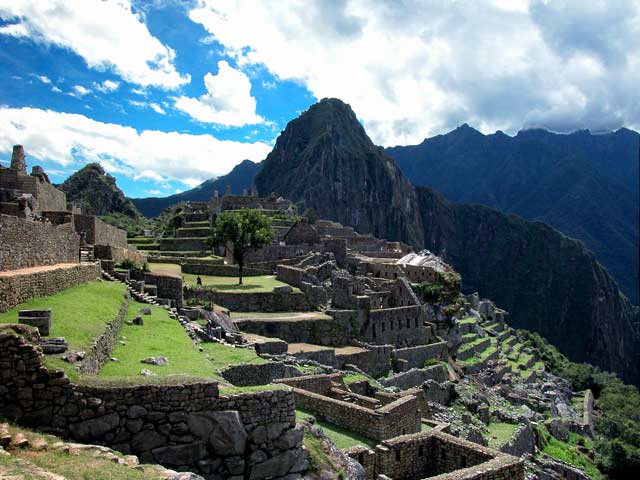
Machu Picchu (literally means "old peak"; sometimes called the "Lost City of the Incas") is a well-preserved pre-Columbian Inca ruin located on a high mountain ridge, at an elevation of about 7,710 feet (2,350 m). Machu Picchu is located above the Urubamba Valley in modern-day Peru. Geographic coordinates: 13° 9' 23? S 72° 32' 34? W. The site is probably the most familiar symbol of the Inca Empire, due to its unique location, its geological features, and its late discovery in 1911. In recent times the site has been designated as a UNESCO World Heritage Site and has been the subject of concerns about the damage of tourism.
It is thought the city was built by the Sapa Inca Pachacuti starting in about 1440 and was inhabited until the Spanish conquest of Peru in 1532. Archeological evidence (together with recent work on early colonial documents) shows that Machu Picchu was not a conventional city, but a country retreat town for Incan nobility (similar to the Roman villas). The site has a large palace and temples to Incan deities around a courtyard, with other buildings for support staff. It is estimated that a maximum of only about 750 people resided in Machu Picchu at any one time, and probably only a small fraction of that number lived in the town during the rainy season and when no noblity were visiting.
It is thought that the site was chosen for its unique location and geological features. It is said that the silhouette of the mountain range behind Machu Picchu represents the face of the Inca looking upward towards the sky, with the largest peak, Waynapicchu, representing his nose. The Inca believed that the solid rock of the Earth should not be cut and so built this city from rock quarried from loose boulders found in the area. Some of the stone architecture uses no mortar, but rather relied on extremely precise cutting of blocks that results in walls with cracks between stones through which a credit card will not pass.
The city was not rediscovered until July 24, 1911, when Yale University history professor Hiram Bingham III first visited it while exploring old Inca roads in the area. He was led to Machu Picchu by Quechuans who were living in Machu Picchu in the original Incan infrastructure. Bingham made several more trips and conducted excavations on the site through 1915. He wrote a number of books and articles about Machu Picchu; his popular account, Lost City of the Incas, became a bestseller.
In 1913, the site received a significant amount of publicity after the National Geographic Society devoted their entire April 1913 issue to Machu Picchu.
In 2003, some 400,000 people visited Machu Picchu, and UNESCO has expressed concern about the damage this volume of tourism is causing to the site. Peruvian authorities insist that there is no problem, and that the remoteness of the site will impose natural limits on tourism. Periodically, proposals are made to install a cable car to the site, but such proposals have so far always been rejected.


Friday, December 10, 2010

WORLD WONDERS


The Great Wall of China is a series of stone and earthen fortifications in northern China, built originally to protect the northern borders of the Chinese Empire against intrusions by various nomadic groups. Several walls have been built since the 5th century BC that are referred to collectively as the Great Wall, which has been rebuilt and maintained from the 5th century BC through the 16th century. One of the most famous is the wall built between 220–206 BC by the first Emperor of China, Qin Shi Huang. Little of that wall remains; the majority of the existing wall was built during the Ming Dynasty.he Great Wall stretches from Shanhaiguan in the east, to Lop Nur in the west, along an arc that roughly delineates the southern edge of Inner Mongolia. The most comprehensive archaeological survey, using advanced technologies, has recently concluded that the entire Great Wall, with all of its branches, stretches for 8,851.8 km (5,500.3 mi). This is made up of 6,259.6 km (3,889.5 mi) sections of actual wall, 359.7 km (223.5 mi) of trenches and 2,232.5 km (1,387.2 mi) of natural defensive barriers such as hills and rivers.


T

WORLD WONDERS


Petra is a historical and archaeological city in the Jordanian governorate of Ma'an that is known for its rock cut architecture and water conduits system. Established sometime around the 6th century BC as the capital city of the Nabataeans, it is a symbol of Jordan as well as its most visited tourism attraction.It lies on the slope of Mount Hor in a basin among the mountains which form the eastern flank of Arabah (Wadi Araba), the large valley running from the Dead Sea to the Gulf of Aqaba. Petra has been a UNESCO World Heritage Site since 1985.


WORLD WONDERS

The Colosseum, which stands near the center of present-day Rome, is probably the finest surviving example of ancient Rome architecture and one of the most recognizable landmarks of history. 

The Colosseum is shaped like a modern time football court and could seat as many as 50000 spectators. Built in the form of an ellipse, the Colosseum has a perimeter of 1729 feet and height of 161 feet. The oval-shaped, sand-covered floor of the arena originally could be flooded for water spectacles. Later, cages for animals and people were installed beneath the arena. The amphitheater was built on a concrete platform about 42 feet thick. On top this stood what was known as the subterranean area. It was here that the equipment and stage scenery used in the battle spectacles was held. The actual arena itself was made of wood, which is now gone. The edges of the arena were protected by high nets with spiked poles at their top to prevent to the wild animals from getting out. The completed Colosseum rose to four stories. The first three stories contained symmetrical arches, each of which was adorned with a statue. Also, the three tiers of arcades are faced by three-quarter columns and entablatures, Doric in the first story, Ionic in the second, and Corinthian in the third. Above them is a attic story with Corinthian pilaster and small square window openings in alternate bays. Moreover, the construction utilized a careful combination of types: concrete for the foundations, travertine for the piers and arcades, tufa infill between piers for the walls of the lower two levels, and brick-faced concrete used for the upper levels and for most of the vaults. 


WORLD WONDERS

About one hundred miles east of Delhi in Northern India stands the city Agra. Within it lies perhaps one of the greatest architectural monument ever built. Designed by a Turkish architect, the monument was made of white marble. It stands as a monument to represent the love that Shah Jahan had for his favorite wife, Mumtaz Mahal. The building took about 11 years to complete even though it has been said by stories that it took about 22 years and required some twenty thousand workers.we admire this monument as a master piece of architectural engineering.Through years,taj mahal has been a major tourist  attraction place in india.tourists from all around the world come in millions each year to observe this monument of eternal love.