Twice-Told Tales (aka "Nathaniel Hawthorne's Twice-Told Tales" and "Nights of Terror") (1963)
Starring: Vincent Price, Sebastian Cabot, Beverly Garland, Brett Halsey, Joyce Taylor, and Mari Blanchard
Director: Sidney Salkow
Rating: Eight of Ten Stars
"Twice-Told Tales" is a collection of three short films loosely based on stories by Nathaniel Hawthorne. They are a nice mix of melodrama and horror, and, although they unfold somewhat slowly (and those who think a horror movie has to have gore and violence or it not worth seeing will be bored), each tale features some great classical style acting and chilling twist endings that will keep lovers of well-done dramas entertained.
Vincent Price plays the lead in two of the three segments, and he displays clearly why he was a rising leading man in Hollywood until he shifted gears career-wise and became a star of horror films. Although he is the villain in each piece, he carries himself with such an air of melancholy-tinged elegance that one can't but feel a little sympathy for the evil men he portrays.
In film opens with "Dr. Heidegger's Experiment." Here, Price plays the best friend of the title character (played by Sebastian Cabot), a scientist who discovers a literal fountain of youth in the crypt of long-dead woman they both loved. The two friends regain their their youth, and even manage to resurrect their beloved Sylvia (Blanchard). Unfortunately, turning back the hands of time also resurrects dark secrets long buried.
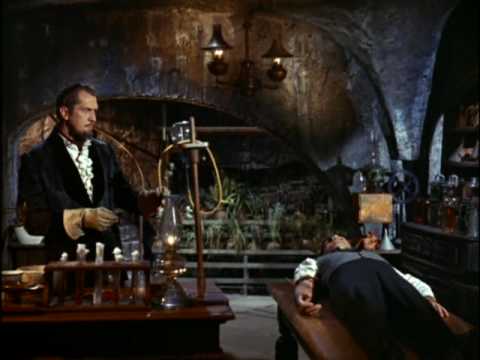
The second story is "Rappaccini's Daughter". In it, Gionvanni (Halsey) falls in love with a mysterious beauty (Taylor) who never leaves the mansion and walled garden she shares with her father, Rappaccini (Price). It soon comes to light that Rappaccini used chemistry to turn his daughter's very touch poisonous to protect her from sin... and when it becomes clear to him that Giovanni and his daughter love each other, he takes steps to ensure they'll be together and faithful to each other forever. This is perhaps the oddest and saddest of the three tales, and while Price's character is definitely a total madman in this story, he still manages to bring a sympathetic quality to Rappaccini in his performance.
Finally, we have a very loose adaptation of Hawthorne's novel "House of Seven Gables" where Gerald Pyncheon (Price) returns to his his ancestral home with his wife Alice (Garland) and awakens a restless spirit and a deadly curse. While the first two stories were tragedies with "mad science" overtones and nifty twist endings , this one is pretty much a standard haunted house story with all the various expected elements used exactly as anticipated. It's not only a fairly bad take on Hawthorne's novel, but it's also the weakest short film here, and it was one that saw me wishing for the credits to start rolling. Still, Price gives a good performance, and there's never anything wrong with watching someone as lovely as Beverly Garland, even if she is in some nicely put-together dreck. (Oh... and the model shot of the house of the title is probably one of the worst bit of special effects since the Alpine village in Hitchcock's "The Lady Vanishes.")
Although it ends on a down-note, "Twice-Told Tales" is an interesting anthology film. It's a film I recommend highly to fans of Vincent Price, particularly if they've not been exposed to his pre-Corman and pre-Castle days. He is in great form in this film.
Showing posts with label Vincent Price. Show all posts
Monday, December 26, 2011
Tuesday, November 29, 2011
'Tales of Terror' is Roger Corman at his best
Tales of Terror (aka "Edgar Allan Poe's Tales of Terror") (1962)
Starring: Vincent Price, Peter Lorre, Basil Rathbone, Leona Gage, Maggie Pierce, Joyce Jameson, and Debra Paget
Director: Roger Corman
Rating: Eight of Ten Stars
This is the film that convinced me that Roger Corman actually could make a good movie, when I first saw it. My first exposure to his work was "The Wasp Woman" and "The Terror", not exactly Corman at his best.
"Tales of Terror" is an anthology film that features three shorts loosely adapted from stories by Edgar Allan Poe, and further tied together by the fact that each star Vincent Price in a different role.
First up, we have the chilling and tragic tale "Morella", where a young woman (Pierce) returns to her childhood home in one last attempt to connect with the father who rejected her (Price) after the death of her mother. Moody throughout and downright terrifying at the end, this story is a excellent excursion into the dark corners of the human heart and a fabulous horror story.
Next, we have "The Black Cat", which folds the story of the same name and "A Cask of Amontillado" into one tale of dark comedy as a drunkard (Lorre) ends up in a hum-dinger of a drinking competition with a snooty wine-taster (Price) after he stumbles into an annual wine festival. When he later discovers that wine-taster has been having an affair with his wife, he decides to take drastic action. This tale is characterized by a taut balance between comedy and a brooding sense of dread, with the on-screen interplay between Lorre and Price being a fabulous bit of movie magic. (They're even better here than in "A Comedy of Terrors".)
Finally, we are presented with "The Facts in the Case of M. Valdemar", an exceedingly creepy tale of a greedy mesmerist (Rathbone) who uses hypnosis to trap the spirit of a dying man (Price) between this world and the next... with terrible consequences for everyone involved. This segment isn't as stunning visually as the first two, but it gets plenty skin-crawly as it builds toward its climax.
The ever-present cheapness in a Corman film is invisible here. I've no doubt that every dollar is present on the screen, but the crew working on this film built some great sets, they're beautifully lit, and the camera work and editing is excellent; the material here looks far better than what I still think of as "typical" Corman. Further, there's no obvious padding to dispel the mood of horror and dread in any of the three stories.
All the principal actors (and even some of the bit-players) give excellent performances. I would even venture that Price might not be the best in this film--Lorre's comedic performance is fabulous, as is Rathbone's turn as a blackhearted villain. (That's not to say that Price isn't great in all the three parts he plays.)
If you like classic horror movies, I'm sure you'll love "Tales of Terror." If you tend to sneer at Corman films, as I used to, maybe this one will show that he can be really, really good when working with the right cast, writers, crew... and when he takes more time than 48 hours to shoot a film.
Starring: Vincent Price, Peter Lorre, Basil Rathbone, Leona Gage, Maggie Pierce, Joyce Jameson, and Debra Paget
Director: Roger Corman
Rating: Eight of Ten Stars
This is the film that convinced me that Roger Corman actually could make a good movie, when I first saw it. My first exposure to his work was "The Wasp Woman" and "The Terror", not exactly Corman at his best.
"Tales of Terror" is an anthology film that features three shorts loosely adapted from stories by Edgar Allan Poe, and further tied together by the fact that each star Vincent Price in a different role.
First up, we have the chilling and tragic tale "Morella", where a young woman (Pierce) returns to her childhood home in one last attempt to connect with the father who rejected her (Price) after the death of her mother. Moody throughout and downright terrifying at the end, this story is a excellent excursion into the dark corners of the human heart and a fabulous horror story.
Next, we have "The Black Cat", which folds the story of the same name and "A Cask of Amontillado" into one tale of dark comedy as a drunkard (Lorre) ends up in a hum-dinger of a drinking competition with a snooty wine-taster (Price) after he stumbles into an annual wine festival. When he later discovers that wine-taster has been having an affair with his wife, he decides to take drastic action. This tale is characterized by a taut balance between comedy and a brooding sense of dread, with the on-screen interplay between Lorre and Price being a fabulous bit of movie magic. (They're even better here than in "A Comedy of Terrors".)
Finally, we are presented with "The Facts in the Case of M. Valdemar", an exceedingly creepy tale of a greedy mesmerist (Rathbone) who uses hypnosis to trap the spirit of a dying man (Price) between this world and the next... with terrible consequences for everyone involved. This segment isn't as stunning visually as the first two, but it gets plenty skin-crawly as it builds toward its climax.
The ever-present cheapness in a Corman film is invisible here. I've no doubt that every dollar is present on the screen, but the crew working on this film built some great sets, they're beautifully lit, and the camera work and editing is excellent; the material here looks far better than what I still think of as "typical" Corman. Further, there's no obvious padding to dispel the mood of horror and dread in any of the three stories.
All the principal actors (and even some of the bit-players) give excellent performances. I would even venture that Price might not be the best in this film--Lorre's comedic performance is fabulous, as is Rathbone's turn as a blackhearted villain. (That's not to say that Price isn't great in all the three parts he plays.)
If you like classic horror movies, I'm sure you'll love "Tales of Terror." If you tend to sneer at Corman films, as I used to, maybe this one will show that he can be really, really good when working with the right cast, writers, crew... and when he takes more time than 48 hours to shoot a film.
Thursday, April 14, 2011
Classic Horror: The Best of the Invisible Man
The Invisible Man is an honored member of the Universal Pictures' pantheon of Terror Titans, even if only three of the five films featuring the concept/character were actual horror films, and only two of those were any good.
In this post, I offer reviews of the two true horror entries in the original Invisible Man film cycle. If you want to read reviews of the other two worthwhile entries in the series, click here to read my review of Invisible Agent (where the grandson of the original Invisible Man takes on the Nazis) and click here to read my review of "The Invisible Woman" (a comedy about a model turned invisible through the miracle of mad science).
The Invisible Man (1933)
Starring: Claude Rains, William Harrigan, Una O'Connor, Gloria Stuart, Forrester Harvey and Henry Travers
Director: James Whale
Rating: Eight of Ten Stars
Chemist Frank Griffin (Rains) develops a formula that turned him invisible. He goes on a homicidal rampage in rural Britain after it also drives him insane.
![Claude Rains and Gloria Stuart in a scene from]()
"The Invisible Man" is another true classic from the formative years of the horror genre. It's quite possibly the first horror comedy and it's black humor holds up nicely even today--arrogant scientists, simple country bumpkins and incompetent cops never go out of style!
The film's special effects also hold up surprisingly well, with simple techniques employed here that were used over and over until CGI came fully into its own but rarely used as well as they were here. (Yes, there are a few places where one can see the matting, but the "invisible action" here is depicted better than it is in many films made with much more sophisticated special effects technology.)
And finally, the film has a literate, finely honed script with loads of tension that effectively translates the mood of H.G. Wells' original novel to the screen. The characters seem well-rounded and believable, and this, even more than the special effects, make the movie such a pleasure to watch even now. The film even manages to capture the point about loss of identity resulting in loss of connection with the world around you and ultimately insanity (even if the movie attributes Griffin's madness first and foremost to the chemical concoction he's created.)
Lovers of classy horror and sci-fi films owe it to themselves to check this one out. The same is true if you have an appreciation for dark comedies.
The Invisible Man Returns (1940)
Starring: Vincent Price, Cedric Hardwicke, Nan Grey, Cecil Kellaway, John Sutton and Alan Napier
Director: Joe May
Rating: Seven of Ten Stars
A wrongly convicted man (Price) uses an invisibility serum to escape execution and find the murderer who framed him. But, even with the help of his loving fiance (Grey) and his loyal best friend (Sutton), can he track the killer before he is driven mad by the substance that renders him invisible?

"The Return of the Invisible Man" is a well-conceived sequel. It's got significant ties to the original, retains some of the same basic themes, but presents a completely different and unique story. Too often, sequels either shoehorn connections to the film into the story in an artificial manner or have so little to do with the original that one wonders why a connection was even drawn (well, aside from naked greedy attempts to ride on the coat-tails of another film's success).
A well-scripted mystery is added to the invisible man shenanigans... and although it's a bit slow in getting started, it is a gripping tale once it gets going. The mystery isn't terribly hard to solve for those who like playing along--there really is only one suspect and the film never launches any serious attempt to divert the audience's attention from that villain. However, plenty of suspense arises from watching the invisible man start to lose his mind even as he identifies his prey.
The great cast of the film is also to be credited with its success. Most noteworthy among the actors are Vincent Price lends his distinctive voice to the film's unseen protagonist, and Cecil Kellaway who appears in a rare dramatic role as the inscrutable Inspector Sampson of Scotland Yard.
The only complaint I have with the film are the invisibility effects. Whether due to a lack of budget or creativity on the part of the director and special effects crew, there is nothing here as impressive as the cinematic tricks used to sell the presence of an invisible character on screen as was found in the original "Invisible Man" nor in the "Invisible Woman", a comedy dating from the same year yet featuring far more impressive effects. (Nothing in "The Invisible Man Returns" comes close to the bicycle stunt in "The Invisible Man" or the stockings scene in "The Invisible Woman".)
However, the solid story and excellent cast make up for the shortcomings in the special effects department.
In this post, I offer reviews of the two true horror entries in the original Invisible Man film cycle. If you want to read reviews of the other two worthwhile entries in the series, click here to read my review of Invisible Agent (where the grandson of the original Invisible Man takes on the Nazis) and click here to read my review of "The Invisible Woman" (a comedy about a model turned invisible through the miracle of mad science).
The Invisible Man (1933)
Starring: Claude Rains, William Harrigan, Una O'Connor, Gloria Stuart, Forrester Harvey and Henry Travers
Director: James Whale
Rating: Eight of Ten Stars
Chemist Frank Griffin (Rains) develops a formula that turned him invisible. He goes on a homicidal rampage in rural Britain after it also drives him insane.
"The Invisible Man" is another true classic from the formative years of the horror genre. It's quite possibly the first horror comedy and it's black humor holds up nicely even today--arrogant scientists, simple country bumpkins and incompetent cops never go out of style!
The film's special effects also hold up surprisingly well, with simple techniques employed here that were used over and over until CGI came fully into its own but rarely used as well as they were here. (Yes, there are a few places where one can see the matting, but the "invisible action" here is depicted better than it is in many films made with much more sophisticated special effects technology.)
And finally, the film has a literate, finely honed script with loads of tension that effectively translates the mood of H.G. Wells' original novel to the screen. The characters seem well-rounded and believable, and this, even more than the special effects, make the movie such a pleasure to watch even now. The film even manages to capture the point about loss of identity resulting in loss of connection with the world around you and ultimately insanity (even if the movie attributes Griffin's madness first and foremost to the chemical concoction he's created.)
Lovers of classy horror and sci-fi films owe it to themselves to check this one out. The same is true if you have an appreciation for dark comedies.
The Invisible Man Returns (1940)
Starring: Vincent Price, Cedric Hardwicke, Nan Grey, Cecil Kellaway, John Sutton and Alan Napier
Director: Joe May
Rating: Seven of Ten Stars
A wrongly convicted man (Price) uses an invisibility serum to escape execution and find the murderer who framed him. But, even with the help of his loving fiance (Grey) and his loyal best friend (Sutton), can he track the killer before he is driven mad by the substance that renders him invisible?

"The Return of the Invisible Man" is a well-conceived sequel. It's got significant ties to the original, retains some of the same basic themes, but presents a completely different and unique story. Too often, sequels either shoehorn connections to the film into the story in an artificial manner or have so little to do with the original that one wonders why a connection was even drawn (well, aside from naked greedy attempts to ride on the coat-tails of another film's success).
A well-scripted mystery is added to the invisible man shenanigans... and although it's a bit slow in getting started, it is a gripping tale once it gets going. The mystery isn't terribly hard to solve for those who like playing along--there really is only one suspect and the film never launches any serious attempt to divert the audience's attention from that villain. However, plenty of suspense arises from watching the invisible man start to lose his mind even as he identifies his prey.
The great cast of the film is also to be credited with its success. Most noteworthy among the actors are Vincent Price lends his distinctive voice to the film's unseen protagonist, and Cecil Kellaway who appears in a rare dramatic role as the inscrutable Inspector Sampson of Scotland Yard.
The only complaint I have with the film are the invisibility effects. Whether due to a lack of budget or creativity on the part of the director and special effects crew, there is nothing here as impressive as the cinematic tricks used to sell the presence of an invisible character on screen as was found in the original "Invisible Man" nor in the "Invisible Woman", a comedy dating from the same year yet featuring far more impressive effects. (Nothing in "The Invisible Man Returns" comes close to the bicycle stunt in "The Invisible Man" or the stockings scene in "The Invisible Woman".)
However, the solid story and excellent cast make up for the shortcomings in the special effects department.
Thursday, March 17, 2011
There ain't much Irish in this Banshee
According to the original Irish legends, the banshee is a spirit that followed five powerful Irish clans and her mournful howls would fill the darkness of the eve before one of their numbers were to come to a dark end. Recent tales have expanded the nature of the banshee to a more general nature... although one has to wonder if the creators of this film even bothered looking up the word "banshee" in a dictionary.
In honor of St. Patrick's Day, I present a review of a movie featuring the Banshee... kinda. And while the Banshee may be an Irish spirit, it admittedly has about as much to do with St. Patrick as this movie has to do with the Banshee. (This is an expanded version of a review that appears in Movies You Should (Die Before You) See.)
Cry of the Banshee (1970)
Starring: Vincent Price, Hilary Dwyer, Patrick Mower, and Elizabeth Bergner
Director: Gordon Hessler
Rating: Three of Ten Stars
When the ruthless, psychopathic Lord Edward Whitman (Price) has a coven of witches massacred, the leader (Bergner) escapes and calls forth a Banshee that will visit death and destruction upon the entire Whitman line, until it exists no more.
Every so often, a movie comes along where every character in it is so unlikeable or so one-dimensional and flat that the viewer really doesn't care what happens to them, and has no one in particular to root for or identify with. "Cry of the Banshee" is one of those films.
The writing here is so bad that not even Vincent Price, who usually manages to bring a fresh feel to even the corniest villian, and some degree of twisted charm to even the worst psychopathic murderer, can tease anything from the character of Edward Whitman other than "this is a bloodthirsty upperclass twit in Elizabethan England who gets off on killing buxom peasant wenches suspected of performing pagan rituals in the woods."
The opposite side of the story--the coven leader Oona--is a performance that stands as a tribute to the questionable gift of overacting. Then there's the story problem that her "revenge" is as broad and uncalled for as the atrocities of Lord Edward's random witch-hunts.
The most glaring example of how bad this movie is the complete illiteracy of anyone involved with the production side. A simple consultation of a dictionary to find the defintion of "banshee" would have gone a long way to making this movie a little less dumb.
The film almost redeems itself at the end with a nicely executed twist (even if the sudden shift in Price's character was a little odd) and there's some honest-to-god horror to be found there, as opposed to simple sadism and brutality, but it's too little and too late. By then, "Cry of the Banshee" is firmly in the Bad category. (There are worse--and director Hessler is responsible for some them, such as "Scream and Scream Again"--but there are also far, far better.)
--
Trivia: The opening titles sequence was by Terry Gilliam of "Monte Python" and "Time Bandits" fame. It's pretty nifty and more creative than "Cry of the Banshee" deserves.
In honor of St. Patrick's Day, I present a review of a movie featuring the Banshee... kinda. And while the Banshee may be an Irish spirit, it admittedly has about as much to do with St. Patrick as this movie has to do with the Banshee. (This is an expanded version of a review that appears in Movies You Should (Die Before You) See.)
Cry of the Banshee (1970)
Starring: Vincent Price, Hilary Dwyer, Patrick Mower, and Elizabeth Bergner
Director: Gordon Hessler
Rating: Three of Ten Stars
When the ruthless, psychopathic Lord Edward Whitman (Price) has a coven of witches massacred, the leader (Bergner) escapes and calls forth a Banshee that will visit death and destruction upon the entire Whitman line, until it exists no more.
Every so often, a movie comes along where every character in it is so unlikeable or so one-dimensional and flat that the viewer really doesn't care what happens to them, and has no one in particular to root for or identify with. "Cry of the Banshee" is one of those films.
The writing here is so bad that not even Vincent Price, who usually manages to bring a fresh feel to even the corniest villian, and some degree of twisted charm to even the worst psychopathic murderer, can tease anything from the character of Edward Whitman other than "this is a bloodthirsty upperclass twit in Elizabethan England who gets off on killing buxom peasant wenches suspected of performing pagan rituals in the woods."
The opposite side of the story--the coven leader Oona--is a performance that stands as a tribute to the questionable gift of overacting. Then there's the story problem that her "revenge" is as broad and uncalled for as the atrocities of Lord Edward's random witch-hunts.
The most glaring example of how bad this movie is the complete illiteracy of anyone involved with the production side. A simple consultation of a dictionary to find the defintion of "banshee" would have gone a long way to making this movie a little less dumb.
The film almost redeems itself at the end with a nicely executed twist (even if the sudden shift in Price's character was a little odd) and there's some honest-to-god horror to be found there, as opposed to simple sadism and brutality, but it's too little and too late. By then, "Cry of the Banshee" is firmly in the Bad category. (There are worse--and director Hessler is responsible for some them, such as "Scream and Scream Again"--but there are also far, far better.)
--
Trivia: The opening titles sequence was by Terry Gilliam of "Monte Python" and "Time Bandits" fame. It's pretty nifty and more creative than "Cry of the Banshee" deserves.
Wednesday, October 6, 2010
Madness goeth before fall in the House of Usher
The Fall of the House of Usher (aka "House of Usher") (1960)
Starring: Mark Damon, Vincent Price, Myrna Fahey and Harry Ellerby
Director: Roger Corman
Rating: Eight of Ten Stars
When Philip Winthrop (Damon) travels to an remote estate with the intent of bringing his fiancee Madeleine Usher (Fahey) back with him to Boston so they can be married, he learns from her brother Roderick (Price) that she and he both suffer from a degenerative disease that will eventually kill them. But things are not quite what they seem, and Withrop will come face to face with many horrors as he witnesses the fall of the House of Usher.

"The Fall of the House of Usher" was the first in a string of Edgar Allan Poe adaption from producer/director Roger Corman, many of which captured the spirit of Poe's tales but few of which were faithful to their source material. This one is not only fairly close to the original story, but it is quite possibly the best film that Roger Corman ever helmed.
Almost every director produces a masterpiece. This film may well have been Roger Corman's.
Not only is Corman at his best, but I don't think Vincent Price has ever been more successful at portraying a vile, quietly insane character as he does with Roderick Usher. Mark Damon provides a great foil as the handsome, heroic suitor, and, although her role is mostly that of a gorgeous damsel in distress--at least until the film's terrifying conclusion, Myrna Fahey's performance is of a caliber that makes it clear that her death from cancer at the age of 40 was a real loss to the art of movie making.
Featuring excellent pacing with a mounting tension that results in the final 30 minutes of the film being some of the most intense and scary horror footage ever recorded, great acting with just enough melodramatic touches to add a touch of gothic romance to the film's horror- and madness-soaked atmosphere.
If you're looking for a movie that will scare the heck out of you without resorting to gore and graphic violence, then you need look no further than this movie. The nearly fifty years that has passed since it was made has done nothing to dull its impact. It may be a little slow-building to be suitable Halloween party viewing, but it's a film that should be seen by anyone who appreciates well-done horror movies... and it's a must-see if you're a fan of the sort of gothic horror that was embodied in the Hammer films from the 1950s and 1960s, or in the Ravenloft dark fantasy world.
Starring: Mark Damon, Vincent Price, Myrna Fahey and Harry Ellerby
Director: Roger Corman
Rating: Eight of Ten Stars
When Philip Winthrop (Damon) travels to an remote estate with the intent of bringing his fiancee Madeleine Usher (Fahey) back with him to Boston so they can be married, he learns from her brother Roderick (Price) that she and he both suffer from a degenerative disease that will eventually kill them. But things are not quite what they seem, and Withrop will come face to face with many horrors as he witnesses the fall of the House of Usher.

"The Fall of the House of Usher" was the first in a string of Edgar Allan Poe adaption from producer/director Roger Corman, many of which captured the spirit of Poe's tales but few of which were faithful to their source material. This one is not only fairly close to the original story, but it is quite possibly the best film that Roger Corman ever helmed.
Almost every director produces a masterpiece. This film may well have been Roger Corman's.
Not only is Corman at his best, but I don't think Vincent Price has ever been more successful at portraying a vile, quietly insane character as he does with Roderick Usher. Mark Damon provides a great foil as the handsome, heroic suitor, and, although her role is mostly that of a gorgeous damsel in distress--at least until the film's terrifying conclusion, Myrna Fahey's performance is of a caliber that makes it clear that her death from cancer at the age of 40 was a real loss to the art of movie making.
Featuring excellent pacing with a mounting tension that results in the final 30 minutes of the film being some of the most intense and scary horror footage ever recorded, great acting with just enough melodramatic touches to add a touch of gothic romance to the film's horror- and madness-soaked atmosphere.
If you're looking for a movie that will scare the heck out of you without resorting to gore and graphic violence, then you need look no further than this movie. The nearly fifty years that has passed since it was made has done nothing to dull its impact. It may be a little slow-building to be suitable Halloween party viewing, but it's a film that should be seen by anyone who appreciates well-done horror movies... and it's a must-see if you're a fan of the sort of gothic horror that was embodied in the Hammer films from the 1950s and 1960s, or in the Ravenloft dark fantasy world.
Wednesday, January 20, 2010
Happy Birthday, Mr. Poe! (Belated)
I tried to schedule posts to go up automatically... and I screwed up.
In celebration of Jan. 19, the birthday of Edgar Allan Poe, here's a review of one of the best movies based on his writings.
Masque of the Red Death (1964)
Starring: Vincent Price, Hazel Court, Jane Asher, Patrick Magee, and David Weston
Director: Roger Corman
Rating: Eight of Ten Stars

As a plague known as the Red Death sweeps across the countryside, Prince Prospero (Price) believes the walls of his castle and his devotion to Satan will keep him and his foul friends safe. But one evil act too many brings a mysterious guest to a masquerade ball the prince throws.
This is the only Roger Corman film I've seen so far that I felt I could give a glowing review without tacking on ANY qualifications. "Masque of the Red Death" is a fine horror film that engages both the mind and the gut as it unfolds. It is proficiently acted, well-scripted and perfectly paced, expertly filmed within amazing sets... everything here is clicking. What's more, the film evokes its horror and dread through a well-told story rather than gore and other special effects. If there ever was a Corman film that should be described as "great" and that is worth seeing by fans of good movies (not just cheesy ones), then this is it.
Vicent Price is in top form as the evil prince, and Hazel Court also shines brightly. It's obvious that some of Corman's very best work was done while filming under the umbrella of a taxshelter in Great Britain, and "Masque of the Red Death" is the best of that work.
Click Here to read the original story this movie was based on, as well as other great works by Edgar Allan Poe.
In celebration of Jan. 19, the birthday of Edgar Allan Poe, here's a review of one of the best movies based on his writings.
Masque of the Red Death (1964)
Starring: Vincent Price, Hazel Court, Jane Asher, Patrick Magee, and David Weston
Director: Roger Corman
Rating: Eight of Ten Stars

As a plague known as the Red Death sweeps across the countryside, Prince Prospero (Price) believes the walls of his castle and his devotion to Satan will keep him and his foul friends safe. But one evil act too many brings a mysterious guest to a masquerade ball the prince throws.
This is the only Roger Corman film I've seen so far that I felt I could give a glowing review without tacking on ANY qualifications. "Masque of the Red Death" is a fine horror film that engages both the mind and the gut as it unfolds. It is proficiently acted, well-scripted and perfectly paced, expertly filmed within amazing sets... everything here is clicking. What's more, the film evokes its horror and dread through a well-told story rather than gore and other special effects. If there ever was a Corman film that should be described as "great" and that is worth seeing by fans of good movies (not just cheesy ones), then this is it.
Vicent Price is in top form as the evil prince, and Hazel Court also shines brightly. It's obvious that some of Corman's very best work was done while filming under the umbrella of a taxshelter in Great Britain, and "Masque of the Red Death" is the best of that work.
Click Here to read the original story this movie was based on, as well as other great works by Edgar Allan Poe.
Subscribe to:
Posts (Atom)


