Showing posts with label High Rating. Show all posts

Friday, June 15, 2012

'Tied in Blood' is an excellent ghost story

Tied in Blood (2012)
Starring: Paul McEwan, Kenneth G. Hodgson, Laura O'Donoughue, Chris Leach, Denise Cooke, and Amie Morris
Director: Matthew Lawrence
Rating: Eight of Ten Stars

Robert (McEwan), a talented professional medium who resorts to phony seances to keep the money flowing when his gift fails him, is asked by a desperate man (Hodgson) to banish the ghost that killed his family. Robert jumps at this chance to use his gift to genuinely help someone, but when he arrives at the haunted house, he is confronted not by the expected malevolent spirit but instead by the confused ghost of the murdered family (Cooke, Leach, and O'Donoughue). As Robert speaks to them, attempting to help them "cross over", a story of ghostly seduction, demonic rage, and deep, dark secrets emerges.


"Tied In Blood" is a slow-burn horror story that is more literary in its feel and execution than most movies you'll see. The horror here doesn't ultimately come from special effects gore splattering everywhere but from the darkness within the characters and how it got there.

The film can be compared to a dark and twisted version of "Ghost Whisperer". The protagonist spends the film communicating with the spirits of the dead in order to help them find peace so they can rest, while trying to prevent the living from screwing up his efforts by reminding the spirits of whatever grief or regrets are keeping them trapped between life and the afterlife. It can also be compared to "Rashomon" or "Five Times That Night" in that we're presented with different, wildly varying accounts of the same series of events, with the truth (or as close as we'll ever get to it) finally emerging at the end. And with "Tied In Blood", it's a horrible truth.

Screenwriter David Ross and director Matthew Lawrence paced the film expertly, producing a lean, straight-to-the-point movie where every scene and every line spoken plays into the mystery of what happened in the house. There is no need here to rely on fake build-ups abd "gotchya scares" because there are plenty of chills in the script itself. In fact, by horror movie standards, the cinematography is rather plain and everything is brightly lit and seemingly cozy and normal... even the creepy abandoned manor visited by the soon-to-be-dead teenaged brother and sister, and the nocturnal visits by the ghost (Amie Morris) are mostly free of spooky shadows. It's a rare and, in case, effective approach that makes the unfolding events all the more disturbing.

The dispensing of the hoary tricks of gothic horror that have been in play since "The Cat and the Canary", this film instead rests on its well-crafted script and the performances by its talented cast. Everyone in the film gives excellent performances, with as much being said with gestures and facial expressions as through the delivery of dialogue. And nowhere in the film is the acting more effective than the interchanges between Laura O'Donoughue and Chris Leach who play bother and sister. Even before their true personalities and relationship emerge through the various telling of events, the viewer can tell there's something not quite right simply through the way O'Donoghue and Leach portray them. It's some great acting, and I hope to see more of both of them in the future.

The same is true of the work of David Ross and Matthew Lawrence, who make their screenwriting and directorial debuts respectively with this film film.

If you're a fan of well-told ghost stories and horror films that command your attention through characters and story rather than special effects, should check out "Tied in Blood" when it debuts on DVD on June 26, 2012.


(This review was based on a preview screener that was provided by distributor Chemical Burn.)

Wednesday, June 6, 2012

Jack Palance is great in dual role

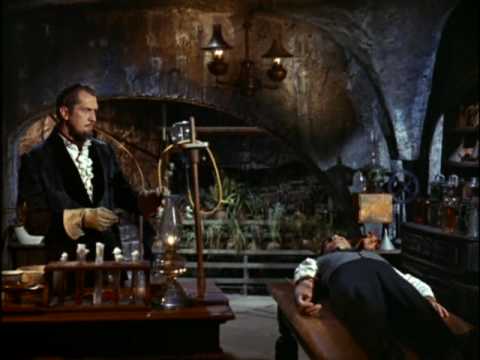
The Strange Case of Dr. Jekyll and Mr. Hyde (1968)
Starring: Jack Palance, Denholm Elliott, Leo Genn, Billie Whitelaw, Oskar Homolka, Gillie Fenwick, and Jeanette Landis
Director: Charles Jarrott
Rating: Nine of Ten Stars

After the scientific establishment laughs at his theories that he can eliminate man's baser instincts with a medical treatment, Dr. Jykell (Palance) tests his concoction on himself and is transformed body and mind into the vicious Mr. Hyde (also Palance).


This 1968 made-for-TV movie is perhaps the best screen adaptation of Robert Louis Stevenson's classic tale. It is more faithful in tone and spirit than actual content--as I suspect a completely faithful adaptation would be a little boring.

That said, this Dan Curtis-produced film is swathed in London fog (via Canadian sound stages) and is drenched with gothic horror atmosphere. It wastes no time in getting going, and within the first 20 minutes, Dr. Jekyll has unleashed Mr. Hyde, and he's racing down the road to personal destruction and murder.

The film is driven more by excellent dialogue than actual action, but what action there is as thrilling as it is chilling... because Jack Palance is at the top of his game in this film.

Palance is absolutely bone-chilling as Mr. Hyde, showing him as every bit the wild and impulsive figure of Victorian repression unleashed... not to mention pure evil; the scenes where he takes on a group of thugs and later when he torments a woman just because he can are some of the most powerful and dark moments Palance ever had on screen. He also, however, manages to invoke a mixture of sympathy, pity, and occasional disgust, in the viewer with his portrayal of Dr. Jykell, an arrogant and foolish man who lets his dark side run wild just because he can. Jykell's ultimate weakness of character is exposed as the film reaches its climax, and Palance builds it up perfectly with his performance.

This is a must-see for fans of gothic horror, Jack Palance, and just well-made films.


Wednesday, May 16, 2012

Skip the prequel, go straight to this one

"The Thing" (1982)
Star: Kurt Russell, Wilford Brimley, Keith David, and David Moffet
Director: John Carpenter
Rating: Eight of Ten Stars

A group of scientists cut off from the rest of the world in Antarctica must deal with an ancient creature that is capable of taking on any form it desires... and that is bent of killing them.


As I sat down ot watch this movie, it dawned on my that I've never actually John Carpenter's version of "The Thing" before. Well, I should have filled that hole in my trashy movie knowledge long ago!

"The Thing" is a text book example of a nearly perfect horror movie. If I was teaching a class in horror films, it would be required viewing and papers would have to be written on it. And it should be required viewing for ANYONE intending to write or direct a horror movie or a monster movie.

In fact, it may be a little too perfect. Because it is so exactly constructed according to the pacing and template that has evolved from "White Zombie" through "Creature from the Black Lagoon" to "Baron Blood" and Carpenter's own "Halloween", few things here surprised me. I was creeped out and shocked at a couple of times, but it pretty much delivered what I expected it to, when I expected it, and pretty much in the manner I expected it.

The one exception is what follows after one of the team members has a heart attack. While I knew something was going to happen, I did not expect what DID happen, nor where it went from there.

If you want to see an extremely well-made horror movie, check out "The Thing". It might not have brought anything new to the genre, but it's still far, far better than 90% of the films being made today.


Thursday, May 3, 2012

Paul Naschy is great in 'Devil's Possessed'

Devil's Possessed (aka "The Marshall of Hell") (1974)
Starring: Paul Naschy, Guillermo Bredeston, Norma Sebre, and Mariano Vidal Molina
Director: León Klimovsky
Rating: Seven of Ten Stars

A one-time courageous and dutiful nobleman, Gilles De Lancre (Naschy) grows twisted and bitter because of perceived slights by the king, is led down the path of madness and Satanism by his lover (Sebre). When his crimes and brutality against the serfs in his domain reach monstrous proportions, his former comrade-in-arms Gaston of Malebranche (Bredeston) takes charge of a growing resistance movement and starts laboring toward ending his reign of terror.


Loosely based on historical figures, including Gilles De Rais who in the mid-1400s had as many as 600 children murdered in the name of "dark arts", "Devil's Possessed" is one of the best films written and directed by B-movie legend Paul Naschy. It's a heady cross between a Robin Hood-style adventure tale and a savage, gory Satanism-fueled horror tale that culminates in a "storming of the castle" sequence that's as exciting on a swashbuckling level as it is chilling on a horror level. Few villains get as neat a send-off as Gilles De Lancre gets here.


Paul Naschy gives a great performance as the increasingly crazy De Lancre, with Norma Sebre complimenting him nicely as De Lancre's cold, repulsively immoral lover. Guillermo Bredeston is likewise solid in the role of the righteous Malebranche, but he is needfully outshone by Naschy. Visually, the film is packed with excellent cinematography that takes full advantage of the natural settings and crumbling castles that serve as the film's locations. The action scenes--be they the jousting tournament at roughly the film's midpoint, or the sword-fights during its finale--are also expertly filmed.

If you like some daring-dos with your horror--or some horror with your swashbuckling--I'm sure you'll get a kick out of this one. While a number of Naschy's penned scripts have their roots in the sort of medieval Satanists of this film--with "The Return of the Wolf Man" and "Horror Rises From the Tomb" coming to mind immediately--this is one of the few where they are front and center in their own time. It's an unusual horror film that's well worth a look.

Wednesday, April 25, 2012

'The Cabin in the Woods' is worth visiting

The Cabin in the Woods (2012)
Starring: Kristen Connolly, Fran Kranz, Chris Hemsworth, Anna Hutchison, Jesse Williams, Bradley Whitford, Richard Jenkins, Amy Acker, Sigourney Weaver, Brian White, Tim De Zern, and Jodelle Ferland
Director: Drew Goddard
Rating: Nine of Ten Stars

Five college kids (Connolly, Hemsworth, Hutchison, Kranz, and Williams) head to an isolated cabin for a weekend of fun, but things don't turn out as planned... for them, or the global organization that is secretly manipulating them.


"Cabin in the Woods" was the happiest cinematic surprise I've had in quite some time. Like most movies I see, I came to it knowing very little about it. Based on what little advertising I'd seen and what little "buzz" I'd heard, I expected a straight "Evil Dead" rip-off (at worst) or "Totem" done right (at best).

It turned out the film was closer to "Totem", but yet not anything like it at all. From the very first scene--which features a pair of stereotypical office workers having a mundane conversation by the water cooler--this is a film that surprises at nearly every turn... but does so through a solid, well-paced story rather than half-assed twists and forced scared. If more scripts were written with the care exhibited here, fewer people would be declaring the horror genre dead.

Because most of the fun in watching the mystery of what is really going on in the film come together, this is a hard movie to review. I can say that it's aimed squarely at fans of B- horror and sci-fi movies and that your level of experience with low-budget cheese will be directly proportional to the level of enjoyment you'll derive from this movie. Like the "Grindhouse" flicks from a few years ago, there is nothing terribly original here, as almost everything is a homage to, or a wry commentary upon, horror and sci-fi genre conventions and movies. But this is an effort far superior to those featured in "Grindhouse" (and the spin-offs), because the parts here add up to something greater than the whole and the movies being referenced.

I've already mentioned the exceptional script at the heart of the film, but the quality of the cast is also a major part of what makes the film so enjoyable. While the young actors portraying the teenaged victims in the cabin are all fine in their various roles as slasher-movie stereotypes, the real fun for me was had watching Bradley Whitford, Richard Jenkins, and Amy Acker as technicians working to manipulate events around the other characters. Although their characters are, more or less, the film's villains, I found myself rooting for them as the film moved into its wild climax.

It's been a while since I've had this much fun watching a movie, and I loved every minute of it. The only complaint I have revolves around a lidded coffee cup that Richard Jenkins' character Sitterson is seen fiddling with in the early scenes. That cup is later placed on a control panel full of buttons and levers, the kind of place you wouldn't want to place a coffee cup that might get knocked over and thus spill liquid on sensitive equipment. But, after this obvious set-up of disaster, the cup just vanishes from the story... and that bugs me. I'm a firm believer in the concept that if "there's a gun in the first act, it hast to be fired by the third." The lack of pay-off for the coffee cup business is the only flaw I could see in this otherwise excellent picture.

Wednesday, April 4, 2012

'Ghost Whisperer' got off to a strong start

I was gifted with Seasons 1 and 2 of "Ghost Whisperer" some time ago, and I recently got around to start watching them. So, I will be reviewing the episodes in this space. I only watched the show once in a blue moon during its five year run on CBS, but every time I did, I was impressed by Jennifer Love Hewitts two great talents. She's also quite an actress.


Ghost Whisperer (Untitled Pilot Episode) (2005)
Starring: Jennifer Love Hewitt, David Conrad, Aisha Tyler, and Wentworth Miller
Director: John Gray
Rating: Eight of Ten Stars

Her entire life, Melinda (Hewitt) has been able to see and communicate with ghosts. As she grew up, she began to pass messages from them to the living, so the restless spirits would feel relieved of their earthly duties and finally be able to move onto the afterlife. Even on her wedding night, she spends time with both the living and the dead... when for the first time one of the dead (Miller) invade her very home in search of help.


"Ghost Whisperer" got off to a strong start with its 2005 pilot episode. A deftly written script that introduces us to likable newly-weds Melinda and Jim--she sees dead people and tries to help them move onto the next life, he is a paramedic and tries to help people stay in this one, which is an interesting arrangement that I'm sure will get play as the show unfolds--and Melinda's sassy employee at the antique store she runs. I expect Melinda's doting and supportive husband will give rise to nearly as many plots as the ghosts he will help as I watch this series... and I expect her employee will come in at a close second, probably not directly but rather through antiques that she brings into the shop that Melinda owns and operates.

The pilot also presents what I know to be the show's formula from what few I've already seen: Melinda encounters a ghosts here and there, but one or two become her focus. After some initial sleuthing and plot complications, she finds the key to helping them resolve the issues that are keeping them in this world. After a tearful goodbye with family members and loved ones, the ghost moves on, and Melinda returns to the arms of her loving husband.

But the pilot also features a near-perfect mix of sappy and creepy that made the best episodes of the show that I've seen so much fun. Just when you think the schmaltz might be going on just a little too thick, scary ghost stuff starts happening.

What I found most entertaining about the pilot episode was the way it time and again made me wonder what it would be like to go through life never knowing if the person sitting across from you is alive or dead... until you realize that you're the only person who can see him. If the show keeps that aspect alive, I think this is going to be lots of fun.

--
Things Learned About Ghosts and The Afterlife in This Episode: Major life-changes for those the departed care about may "awaken" their slumbering, lingering spirits and draw them to the location, even if they don't know why. Ghosts somehow communicate even with the ghosts who are stuck in this world... and sometimes they tell those who are stuck to seek out Melinda for help.

Wednesday, March 14, 2012

'Deadfall Trail' is a chilling tale of survival

Deadfall Trail (2009)
Starring: Shane Dean, Cavin Gray, and Slade Hall
Director: Roz
Rating: Seven of Ten Stars

Experienced outdoorsmen Julian (Dean) and John (Hall) head into the Arizona wilderness together with obnoxious city-boy Paul (Gray) for a survivalist camping trip. When John is seriously injured, Julian apparently suffers a psychotic break and Paul finds himself needing to learn the ways of the wilderness quickly if he is to have any hope at all to survive.


"Deadfall Trail" belongs to the "backwoods survival" horror subgenre, but it is refreshingly free of psycho hicks, toothless townies, and dialogue containing the words "squeal" and "pig".

What it does have are some nice performances by its three stars, each of them coming across as totally believable in the parts they are playing. Shane Dean, as Julian, is particularly noteworthy and interesting to watch, as he does an excellent job of keeping the audience guessing as to whether he is really a dangerous psychopath or just a socially awkward jerk.

Supporting and augmenting the great performances is equally excellent technical work in the photography and sound department. This film has a professional look about it that is entirely too rare among the low-budget pictures that are common stock of distribution labels like Midnight Releasing, Brain Damage Films, and Chemical Burn. I can't even complain too much about the quality of the script... the dialogue and the characters all seem mostly believable. Heck, it even has a "shock ending" that works! Even better, director Roz seems to practice the old adage that "less is more" when it comes to scenes of gore and violence; he leaves our imagination to fill in the details of the film's more horrific scenes, something that lets him avoid the need for prosthetic effects that his budget probably wouldn't be able to support if they were to be done right. It's an approach I wish more low-budget filmmakers would consider taking, as it would make them appear as if they actually knew what they were doing. (Here--most of these movies can show you how it's done.)

That's not to say that "Deadfall Trail" is perfect. There are a couple of moments in the film that were presented to establish aspects of the characters but which also have the feel of "rifle over the fireplace" moments, but we never come back to them. I'm the kind of person who perhaps over-analyzes films I'm watching, but the fact the metaphorical rifles never got fired annoyed me enough to be distracting as the film moved through its climax and I realized that there would be no pay-off to what seemed like perfect set-ups.

Despite minor blemishes, I recommend checking out "Deadfall Trails", especially if you are a fan of the "man vs. nature" or "backwood horror" genres.

Monday, December 26, 2011

It's Price Times Three in 'Twice-Told Tales'

Twice-Told Tales (aka "Nathaniel Hawthorne's Twice-Told Tales" and "Nights of Terror") (1963)
Starring: Vincent Price, Sebastian Cabot, Beverly Garland, Brett Halsey, Joyce Taylor, and Mari Blanchard
Director: Sidney Salkow
Rating: Eight of Ten Stars

"Twice-Told Tales" is a collection of three short films loosely based on stories by Nathaniel Hawthorne. They are a nice mix of melodrama and horror, and, although they unfold somewhat slowly (and those who think a horror movie has to have gore and violence or it not worth seeing will be bored), each tale features some great classical style acting and chilling twist endings that will keep lovers of well-done dramas entertained.

Vincent Price plays the lead in two of the three segments, and he displays clearly why he was a rising leading man in Hollywood until he shifted gears career-wise and became a star of horror films. Although he is the villain in each piece, he carries himself with such an air of melancholy-tinged elegance that one can't but feel a little sympathy for the evil men he portrays.

In film opens with "Dr. Heidegger's Experiment." Here, Price plays the best friend of the title character (played by Sebastian Cabot), a scientist who discovers a literal fountain of youth in the crypt of long-dead woman they both loved. The two friends regain their their youth, and even manage to resurrect their beloved Sylvia (Blanchard). Unfortunately, turning back the hands of time also resurrects dark secrets long buried.


The second story is "Rappaccini's Daughter". In it, Gionvanni (Halsey) falls in love with a mysterious beauty (Taylor) who never leaves the mansion and walled garden she shares with her father, Rappaccini (Price). It soon comes to light that Rappaccini used chemistry to turn his daughter's very touch poisonous to protect her from sin... and when it becomes clear to him that Giovanni and his daughter love each other, he takes steps to ensure they'll be together and faithful to each other forever. This is perhaps the oddest and saddest of the three tales, and while Price's character is definitely a total madman in this story, he still manages to bring a sympathetic quality to Rappaccini in his performance.

Finally, we have a very loose adaptation of Hawthorne's novel "House of Seven Gables" where Gerald Pyncheon (Price) returns to his his ancestral home with his wife Alice (Garland) and awakens a restless spirit and a deadly curse. While the first two stories were tragedies with "mad science" overtones and nifty twist endings , this one is pretty much a standard haunted house story with all the various expected elements used exactly as anticipated. It's not only a fairly bad take on Hawthorne's novel, but it's also the weakest short film here, and it was one that saw me wishing for the credits to start rolling. Still, Price gives a good performance, and there's never anything wrong with watching someone as lovely as Beverly Garland, even if she is in some nicely put-together dreck. (Oh... and the model shot of the house of the title is probably one of the worst bit of special effects since the Alpine village in Hitchcock's "The Lady Vanishes.")

Although it ends on a down-note, "Twice-Told Tales" is an interesting anthology film. It's a film I recommend highly to fans of Vincent Price, particularly if they've not been exposed to his pre-Corman and pre-Castle days. He is in great form in this film.

Tuesday, December 6, 2011

These 'shrooms provide majorily bad trips

Matango (aka "Attack of the Mushroom People") (1962)
Starring: Akira Kubo, Miki Yashiro, Kumi Mizuno, Hiroshi Koizumi, Hiroshi Tachikawa, Yoshio Tsuchiya, and Kenji Sahara
Director: Ishirô Honda
Rating: Seven of Ten Stars

A sudden storm maroons a group of pleasure-boaters on an uncharted island inhabited by strange mushroom creatures.


If "Gilligan's Island" were a horror movie, then this would be it. We have the Skipper and Little Buddy characters (although they're contemptuous of their passengers and treacherously self-centered as opposed to bumbling and helpful); we have Ginger and Mary-Ann (although one is a shy student and the other a bitchy diva), the Millionaire (the owner of the yacht who is always quick to remind everyone else how rich he is... and the bitchy diva stands in for His Wife), and finally, the Professor (who is, well... the Professor).

"Mantango" is a far more effective horror film than I expected to see from the home of Godzilla and who-knows-how-many-other giant monsters. It stars out feeling like an adventure flick, but once our crew of castaways find the wrecked research vessel on the coast of the island where they are marooned, a sense of claustrophobic horror starts to build. And as desperation starts to grip our band of contentious castaways, it becomes more and more evident that they have nowhere to hide from the monsters or each other.

Perhaps the biggest surprise in the film was that the monsters--the mushroom people--were not as silly as I expected them to be. Perhaps it was because they were tied in with the fact that the only way for the characters to survive was to eat food they knew would turn them into monsters, but the effective make-up effects and costumes also played a role.

While I wasn't thrilled with the "shocking twist ending"--which was so bad that it rivals some of the worst modern offenders I've complained about--everything prior to it as very well done. It's a horror film that's free of gore and nudity, so it can be enjoyed by the entire family. Heck, it's even free of stringy-haired girl-ghosts, so this might just be a Japanese horror flick that even those who are sick of them can enjoy!


Tuesday, November 29, 2011

'Tales of Terror' is Roger Corman at his best

Tales of Terror (aka "Edgar Allan Poe's Tales of Terror") (1962)
Starring: Vincent Price, Peter Lorre, Basil Rathbone, Leona Gage, Maggie Pierce, Joyce Jameson, and Debra Paget
Director: Roger Corman
Rating: Eight of Ten Stars

This is the film that convinced me that Roger Corman actually could make a good movie, when I first saw it. My first exposure to his work was "The Wasp Woman" and "The Terror", not exactly Corman at his best.

"Tales of Terror" is an anthology film that features three shorts loosely adapted from stories by Edgar Allan Poe, and further tied together by the fact that each star Vincent Price in a different role.


First up, we have the chilling and tragic tale "Morella", where a young woman (Pierce) returns to her childhood home in one last attempt to connect with the father who rejected her (Price) after the death of her mother. Moody throughout and downright terrifying at the end, this story is a excellent excursion into the dark corners of the human heart and a fabulous horror story.

Next, we have "The Black Cat", which folds the story of the same name and "A Cask of Amontillado" into one tale of dark comedy as a drunkard (Lorre) ends up in a hum-dinger of a drinking competition with a snooty wine-taster (Price) after he stumbles into an annual wine festival. When he later discovers that wine-taster has been having an affair with his wife, he decides to take drastic action. This tale is characterized by a taut balance between comedy and a brooding sense of dread, with the on-screen interplay between Lorre and Price being a fabulous bit of movie magic. (They're even better here than in "A Comedy of Terrors".)

Finally, we are presented with "The Facts in the Case of M. Valdemar", an exceedingly creepy tale of a greedy mesmerist (Rathbone) who uses hypnosis to trap the spirit of a dying man (Price) between this world and the next... with terrible consequences for everyone involved. This segment isn't as stunning visually as the first two, but it gets plenty skin-crawly as it builds toward its climax.

The ever-present cheapness in a Corman film is invisible here. I've no doubt that every dollar is present on the screen, but the crew working on this film built some great sets, they're beautifully lit, and the camera work and editing is excellent; the material here looks far better than what I still think of as "typical" Corman. Further, there's no obvious padding to dispel the mood of horror and dread in any of the three stories.

All the principal actors (and even some of the bit-players) give excellent performances. I would even venture that Price might not be the best in this film--Lorre's comedic performance is fabulous, as is Rathbone's turn as a blackhearted villain. (That's not to say that Price isn't great in all the three parts he plays.)

If you like classic horror movies, I'm sure you'll love "Tales of Terror." If you tend to sneer at Corman films, as I used to, maybe this one will show that he can be really, really good when working with the right cast, writers, crew... and when he takes more time than 48 hours to shoot a film.


Friday, November 11, 2011

'Below' is an ever-changing chiller

Below (2002)
Starring: Bruce Greenwood, Holt McCallany, Olivia Williams, Matt Davis, Nick Chinlund, and Andrew Howard
Director: David Twohy
Rating: Eight of Ten Stars

While on a patrol in the Atlantic during WW2, an American submarine picks up survivors of a strange attack on a medical ship. As they attempt to reach port, the boat comes under attack from a persistent German submarine hunter while seemingly supernatural events start to hinder their efforts to survive.


With "Below", David Twohy does for the war movie what he did for sci-fi with Pitch Black. What starts in the vein of a war drama, soon shifts to an apparent espionage thriller... and eventually morphs into a full-on horror film with the crew of the submarine fighting against a monster outside (the German ship trying its best to send them to the bottom of the sea permanently) and a vengeful ghost within (both an actual supernatural ghost and the guilt harbored by some of the ship's officers surrounding the events that placed Lt. Commander Brice (Greenwood) in the position of acting captain.

With exceptional performances by the entire cast, a clever script that keeps viewers guessing about what is happening and what will come next up to, quite literally, the film's final scene, and excellent special effects, I am left wondering why this film was dumped unceremoniously directly onto the DVD market and quickly relegated to DVD multi-packs. It's a film far more deserving of the obscurity and company it's been relegated to.

If you like war movies and horror movies, "Below" is a film you need to check out.


Wednesday, October 5, 2011

Low-budget but impressive, 'Bio-Slime' delivers goopy scares

Bio-Slime (aka "Contagion") (2010)
Starring: Vinnie Bilancio, Ronnie Lewis, Victoria De Mare, Kelli Kaye, Micol Bartolucci, Magic Ellingson, Gia Paloma, and Ron Fitzgerald
Director: John Lechago
Rating: Seven of Ten Stars

Troy (Bilanco), a down-and-out artist whose talent has been drained away by alcoholism finds himself stalked by a mysterious slime-monster that is absorbing into its mass the occupants of the ramshackle building housing his small studio. Trapped with his agent (Lewis), a few friends (Ellingson, Kaye, and Paloma) and a porn actress from the film studio next door (De Mare), Troy has to find a way to defeat the creature before they all literally become one body and mind.


With a little nip and a tiny tuck here and there to get rid of some bare breasts, "Bio-Slime" is the sort of movie you might find on the SyFy Channel with a "SyFy Channel Original" logo slapped before the opening credits. I'm not saying that to insult the film, but to praise it, because I suspect that John Lachago made this self-funded, self-produced film for a fraction of what those movies are made for... and his end product was as good as most of them, and even better in the effects department.

And those creature effects are the real star in this film. Most of the characters really serve no purpose other than to be monster chow, each suffering a dire, disgusting, and wholly unique fate at the pseudo-pods and tentacles of the slime-monster. All the creature effects, with the exception of a few of the tentacles, were practical effects--make-up, puppetry, and cinematography tricks. And they look great, far better than even some of the computer-generated effects in recent films with budgets 100 or 1,000 times what "Bio-Slime" was made on.

This is a movie that shows that the old methods of making movies are still perfectly adequate--and even superior--to hi-tech wizardry when those time-tested tools are being wielded by talented and skilled artisans like Lechago and his special effects make-up artist Tom Devlin. Devlin and Lechago also worked together on "Killjoy 3", so they obviously make a good team. Here's hoping I see more from them in the future.

I should probably mention that while very little character development takes place in "Bio-Slime", that's not to say there isn't a fully fleshed-out story here. Not only do we get hints of what sort of life the main characters have led beyond the dingy walls they have been trapped within, but there is a sense of history surrounding the monster as well. It emerges from a hi-tech containment device that is opened by the characters through a mixture of curiosity and outright stupidity, it talks about having a life so long that it can't recall where it came from, and the "prologue" and "epilogue" scenes hint and a story far larger and a threat of a possibly global scale that might visit the terror of the few trapped in Troy's studio to the entire world.

But these hints of a larger story are not presented in the hamfisted "Oooo we're setting up a sequel, kids? See? See?! We're not really giving you a complete story here, because we want you back for Part Two and Part Three!" that has become so annoyingly common over the past 15-20 years since everyone thinks their horror or sci-fi film is the next big trilogy or franchise. No... Lechago has written them into the film in an organic way, so we become curious about what might have happened before the film stars and what comes after the end credits finish their crawl. Any dreams he may harbor of sequels is up to him to discuss, but whether he had them or not, he managed to make the events of "Bio-Slime" feel connected to a much larger world, a world that viewers can't but help be curious about; he has planted his "sequel seed" the right way.

(In fact, Lechago did it SO right that I found myself imaging what could be going on... and the players in my on-again, off-again near-future sci-fi role-playing campaign will be dealing with something "borrowed" from this movie. And I can safely say this here, because none of them bother reading my film reviews, because they get enough of my rants in person.)

In addition to well-done story, the film also benefits tremendously from a nice, very traditional-flavored music score. I didn't really notice the music until the film was building to its climax and Troy was getting ready for his final showdown with the slime-creature, but it had been there previously as well. Michael Sean Colin's score is perfect in every respect, deployed at just the right moments and providing just the right intensity needed, mostly blending perfectly with the events unfolding on screen, but stepping to the fore when appropriate as during the film's climax.

Last, but far from least, the film features a great cast of actors. As I mentioned above, the characters in film are mostly here just to get killed, and there isn't much development that takes place with them. However, we get just enough to let us know the type of character each one of them is... and that type is then brought to seemingly full life through the talent and charisma of the actors playing them. While there might not be a whole lot for each actor to work with, what there is, they handle expertly, and they make us care about relatively shallow characters and to feel horrified as each one of them dies. Lachago matched the right actor with the exact right character, and the results are quite impressive. While I can nitpick some of the dialogue and some of the character interaction, I don't feel so inclined, because the actors gave such enjoyable performances, with Victoria De Mare as the bitchy porn actress and Vinnie Bilancio as the reluctant hero who was hoping to turn over a new leaf and make today the first day in the rest of his life, are particularly good in their parts.

"Bio-Slime" has not yet secured wide distribution, which is a shame. I think it's a film that deserves as audience beyond film festivals and cranky typists like yours truly.

(For a sample of what Lechago is capable of, you can check out "Killjoy 3" from Full Moon Features. Click on the link to read my review at the Charles Band Collection.)

Monday, October 3, 2011

The Complete Subspecies

Producer/writer/director Charles Band has put his stamp on nearly 300 horror and sci-fi movies since the late 1970s, but he has yet to top the quality of the "Subspecies" series. These four vampire films were helmed by his frequent 1990s collaborator Ted Nicolaou, and they are not only among the best movies to ever bear Band's famous Full Moon logo, but they are among some of the best vampire movies ever made.


You can read more about Full Moon movies at my other blog "The Charles Band Collection", but I am posting reviews of the Subspecies series here as well, because they are movies that any fan or student of the vampire genre needs to check out. Those of you who enjoy vampire movies with more of a gothic flavor to them than we've seen in recent years will be especially appreciative of the tone and nature of these films. It's a shame it's not been as popular as some of their other creations, such as the Puppet Master films.


Subspecies (1991)
Starring: Laura Mae Tate, Irina Movila, Michelle McBride, Anders Hove, Ivan J. Rado and Michael Watson
Director: Ted Nicolaou
Producer: Ion Ionescu and Charles Band
Rating: Six of Ten Stars

Three pretty grad students (McBride, Movila and Tate) working on disertations are in Transylvania to study the local legends and folk customs, only to find themselves in the middle of a vampiric family feud that's been brewing for centuries and that is now reaching it's brutal, bloody finale.


"Subspecies" is one of the better vampire movies to come out of the 1990s, despite the obvious budget constraints it was made under. It's an interesting merging of the hideous monstrosity vampires from the real legends and early movies and the sexy vampire that grew increasingly popular during the second half of the 20th century, reaching the pinnacle of pop culture success by the mid-1990s.

The story feels a tad slow-moving, partly because the film telegraphs where it's going by leading with the vampires and their blood-feud and then cutting to our three soon-to-be damsels in distress--two very cute blonds and an androgynous brunette--for extended sequences as they wander around old castles and a beautiful countryside, broken only by scenes of the very creepy and disgusting vampire Radu (played by Anders Hove, in a fashion that makes Max Schreck's Count Orlock in "Nosferatu" look like a GQ cover model) rising from his coffin. Radu is so vile that you know he's going to be chewing his way through the cast, so you're going to be feeling a bit impatient with the film as it works its way toward the expected carnage.

However, the film is never dull, nor will you likely be tempted to turn it off. The cast are all good actors and they all play their parts well. The camerawork is excellent and the true Romanian settings lends an atmosphere of realism to the film that few modern-day vampire films can muster.

But when it gets going, it delivers vampire material running the gamut. We've got a disgusting, drooling taloned vampire that's a late 20th century take on the "Nosferatu"-style vampire, we've got sexy vampire babes in nightgowns who might have just flitted over from one of Hammer's Dracula movies, and we've got the male model modern vampire hunk love interest of one of the girls (played by Michael Watson, who was a soap-opera star when the "Subspecies" movie were made).

With all of the good things I'm saying about the film, why am I only giving it a Six Rating, you ask? Well, it's because of the inconsistencies and strange logic surrounding the pint-sized monters that are a mainstay of Charles Band-produced films whether they belong or not. Here, the tiny creatures are nasty demons that are created from severed tips of Radu's fingers, but they fail to seem real because of the truly crappy effects used to bring them to life. For example, in all but one scene, no one bothered to trick in shadows under the creatures, so they appear to be floating over the floor instead of walking on it. They look exactly like what they are: Puppets that have been placed in the scenes via special effects, and they ruin almost every scene they're in because of it.

Despite its flaws, "Subspecies" is a vampire movie that has a little something for everyone, including bare breasts. It's a good start for a series that only gets better.


Subspecies II: Bloodstone (1993)
Starring: Denise Duff, Anders Hove, Melanie Shatner, Kevin Spirtas, Michael Denish, Ion Haiduc and Pamela Gordon
Director: Ted Nicolaou
Rating: Eight of Ten Stars

Young Michelle (Duff) has recently been turned into a vampire and is on the run from the evil vampire prince Radu (Hove) and his twisted, immortal mother (Gordon). Her sister (Shatner) arrives in Romania hoping to help her, but what can a mere mortal do against an ancient vampire who is not only chasing Michelle because he want to possess her, but also because she has stolen the magical Bloodstone?

"Subspecies II: Bloodstone" is a direct continuation of the original "Subspecies"--it picks up just one single night after the final scene of the first movie--and it's one of those very rare sequels that manages to turn out better than the movie it follows. This is an especially remarkable feat because a near-total cast change has taken place and the film takes some very unexpected directions as far as story goes.


The only actor to return in the sequel is Anders Hove, who repeats his performance as the extremely vile, supremely creepy Radu. Although Radu doesn't actually kill anyone in this film--or even sink his vampiric fangs into a single neck!--he's an even more menacing presense than he was in the first film. He developes a maniacal need to possess Michelle, the mortal woman who was made a vampire by Radu's brother Stefan and he seems to start deluding himself into thinking that she will care for him, partly because he murdered Stefan to gain her as a possession. This insanity makes him even spookier than he was in the first movie.

Radu also seems more creepy because of superior camerawork and lighting present in this film. From beginning to end, there is a consistant mood of dread and darkness in every frame of the film, most of it created with simple lighting techniques and camera angles. (The same is true of a number of low-cost effects that seem to make the vampires beings of living shadows--something that is created through well-considered placement of spotlights and cameras and the result is far more effective than more costly special effects could ever have been. (The one time where there is an animated shadow, it looks cheesy, but every time Radu's arrival or departure is demonstrated with shifting, giant shadows it's very dramatic and cool.)

Aside from the competent camera work and lighting, the film also sports a great soundtrack that is fresh yet still reminicent of the one present in the first film. The featured actors also do an excellent job in their various parts, with Denise Duff being particularly noteworthy for stepping into the role of Michelle quite nicely (even if one has to wonder why they chose to go with her as Michelle when Melanie Shatner, the actress who plays Michelle's sister, bears closer physical resemblence to the actress who played Michelle in the first movie) and Michael Denish for serving as the film's comic relief as a scatter-brained Van Helsing-type scholar.

Perhaps the most remarkable aspect of the film when one considers it was produced by Charles Band's Full Moon Entertainnment is the fact that the film follows continuity from the first film very closely. Even with a near-total cast change and the film shifting in tone from Hammer-style gothic horror to a more modern sensibility, the storyline and all the characters remain consistent. Other Full Moon series, like "Puppet Master" and "Trancers" seem to almost go out of their way to screw up story continuity between the various movies, but writer/director Ted Nicolaou chose to actually pay attention to what he'd done before and remain consistent with it even though he took the story in a very different direction than the ending of "Subspecies" seemed to be leading toward.


Subspecies III: Bloodlust (1993)
Starring: Anders Hove, Denice Duff, Melanie Shatner, Kevin Spirtas, Ion Haiduc and Pamela Gordon
Director: Ted Nicolaou
Rating: Seven of Ten Stars

After failing to rescue her sister from the clutches of the evil vampire prince Radu (Hove), Becky (Shatner) enlists the help of a young American diplomat (Spirtas) and a frustrated Romanian police detective (Haiduc) to stage a raid on Castle Vladislav. Meanwhile, Radu is educating the fledgling vampire Michelle (Duff) in how to use her new supernatural powers while attempting to corrupt her soul in order to make her is vampire bride in body as well as spirit.

"Subspecies III: Bloodlust" picks up at the ending of the previous film, seamlessly continuing the storyline of Michella, Radu, and the fearless (but hapless) vampire hunters led by Michelle's sister Becky. Characters who had minor roles in the previous film take the spotlight in this one and they launch a concerted and believable (once one buys into the idea that vampires and witches exist) effort to bring down the vampires.


Once again, the cast all give admirable performances, with Anders Hove making Radu even more disgusting in this installment than he had been in the previous ones. At the same time, however, he manages to evoke some degree of sympathy in the viewer as well. (He's a hideous, murdering monster who has more than just a few screws loose, but the love he has developed for Michelle--however twisted--and the pain it is causing him that she doesn't love him back gives the character a dimension that both makes him increasingly creepy but also gives the viewer something to relate to.)

In some areas, this film continues the trajectory started with the first "Subspecies" sequel, increasing the quality of the film instead of decreasing it as is the usual pattern when it comes to sequels. In other areas, the film holds its own quite nicely, and the end result is a film that will provide a satisfying viewing experience for lovers fo vampire movies of all stripes.

The script for this installment of the series is the best so far. I've already touched upon the great performances given by Anders Hove and Denice Duff, performances that wouldn't have been possible if they hadn't been provided with a great script as their starting point. The scripts quality is also manifested in the comic relief character of Lt. Marin (portrayed by Ion Haiduc), who has scenes that manage to inspire laughter on the heels of, or even during, some of the film's most intense and scary moments. The only complaint I have with the script is that I would have liked to have been given a bit more of a solid ending, but what we have isn't decent enough so that's a minor complaint.

The film isn't as impressive in the photography and lighting area as its predecessor was, with many of the shadow and transformation effects being acheived with animation or composite shots instead of simple lighting and camera tricks. The overall look of the film also isn't quite as dramatic as "Subspecies II", but it's still far beyond the average low-budget horror film and it is still good enough to place this film among the best movies to ever emerge from the Full Moon film factory. It is without a doubt evidence that the Golden Age for Charles Band and his Full Moon label was in the early 1990s. (Band may yet rediscover how to mount productions as impressive as this one, but nothing he has produced in recent years even comes close.)

"Subspecies III: Bloodlust" is one of the very best vampire films ever made. It should be on the "must-see" list of any serious fan or student of genre.


Subspecies 4: Bloodstorm (1998)
Starring: Denice Duff, Anders Hove, Floriela Grappini, Jonathon Morris, Mihai Dinvale, Ion Haiduc, and Ioana Abur
Director: Ted Nicolaou
Producers: Charles Band, Kirk Edward Hansen, and Vlad Paunescu
Rating: Six of Ten Stars

Free of her master Radu (Hove), fledgeling vampire Michelle (Duff) enters the care of a doctor who claims he has discovered a method to reverse her undead condition. But Radu is not ready to let her go yet, and he launches an effort to retrieve her, with the reluctant help of Bucharest's most powerful vampire, Ash (Morris).


In the annals of unnecessary sequels, few are more unnecessary than "Subspecies 4". The 1993 third movie in the series provided a satisfying conclusion to the core story of the series--Michelle resisting Radu's attempts to turn her to evil--and the heroes driving off into the sunrise as Radu was burned to ashy oblivion was a nice period at the end.

But, Charles Band being Charles Band, a successful film WILL have a sequel no matter what, so four years later, Nicolaou was back in the director's chair at the helm of this film, which is an unnecessary sequel not just to the first three "Subspecies" films, but to the tangentially related "Vampire Journals", which was also written and directed by Nicolau. (Or maybe it's a prequel to "Vampire Journals"? With Full Moon's trademark disregard for continuity, I never can be 100 percent sure what they're intending....)

All that said, despite being a wholly unnecessary add-on to the other vampire films, it stands with the original "Subspecies" films and "Vampire Journals" as one of the most visually striking films to ever come from the Band direct-to-home-video assembly lines. Nicolaou really knew how to get the most out of the grand Romanian locations, especially at night. He also continues his flair for stretching his minimal budget to the point where he creates an end-product that looks better than films that cost ten times as much to make.

And while the film is not as good as "Subspecies 3"--the best film from Nicolau I've seen so far--it is an improvement on the overly slow "Vampire Journals".


As for the story, it's a tangle plots and counter-plots that rival the storylines envisioned by the creators of the 1990s roleplaying game "Vampire: The Masquerade" which these movies have always seemed like the perfect adaptation of. Radu plotting to conquer
Michelle, Ash plotting to destroy Radu, Dr. Niculescu's hidden agenda and dark secret... all of these intrigues swirl around Michelle who continues to resist the call of evil and dream of reclaiming her humanity. If you like the Anne Rice-style vampire genre and/or the 1990s White Wolf-style roleplaying games, you'll enjoy this movie.

You'll also enjoy the film if you liked Anders Hove performances in the previous "Subspecies" films. Hove's Radu is every bit as disgusting as he's always been, although he is also even more pathetic in this film that ever before, with his desire for Michelle now fully transformed from its initial need to possess into unrequited love. The rest of the cast do a good job as well, with Jonathon Morris actually being better as Ash in this film than he was in "Vampire Journals" and Ion Haiduc providing gallows-humor comic relief as a police detective turned bumbling vampire (making him the only returning character from the previous two films aside from Michelle and Radu).


Tuesday, September 13, 2011

Dario Argento's first film is one of his best films

The Bird with the Crystal Plumage (aka "The Gallery Murders" and "The Phantom Terror") (1970)
Starring: Tony Musante, Enrico Maria Salerno, Suzi Kendall, Eva Renzi, Renato Romano, and Umberto Raho
Director: Dario Argento
Rating: Seven of Ten Stars

On the eve of returning home to the United States, an American writer in Rome (Mustante) witnesses a brutal attack on a young woman in a gallery (Renzi). The authorities insist he remain in Rome until they clear him as a possible suspect, as they believe the attack and in the meantime, he starts his own investigation. He witnessed the attack, but he feels there was something off with what he saw, but he just can't put his finger on what it was. Meanwhile, the serial killer continues to target young women, seemingly completely at random, and the writer and his beautiful girlfriend (Kendall) end up targeted for death as well.


"The Bird with the Crystal Plumage" was Dario Argento's first film as a director, and I think it is one of his most solid efforts. In fact, it is so solid that I had an even harder time deciding whether my write-up belongs here or with the Argento mystery films over at Watching the Detectives.

This film is, in many ways, a less bloody, more coherent version of "Deep Red," another of Argento's better efforts. Maybe of the same psychological themes are present in this one, including the one where the main character needs to recall something he saw at the scene of a violent crime but that didn't really register with his conscious mind. The conspiracies surrounding the murderer are also similar to one another, and both films "play fair" with the viewer insofar as the surprise twists and the "big reveal" of the killer's identity in both films is set up as the film progresses and the clues that lead to the solution are evident in retrospect. And while "Bird" and "Deep Red" both have characters behaving in unrealistic and stupid ways either for plot convenience or reasons that are only understood to Dario Argento, this film at least doesn't have gaping plot holes that he's trying pass off as red herrings.

More clearly showing Argento's debt to Alfred Hitchcock and Mario Bava than any of the films he made later (including his supposed tribute to Hitchcock that's more a love note to Argento himself in many ways), but also clearly a film coming from his own vision and sensibilities, it's a film that draws its tension as much from what you don't see as what you do see... there are sprays of blood but no outright gore, throats are cut but it happens off scene, and the pictures that will form in your imagination are far more horrible than what appears on screen. Its the intensity generated by the "less is more" approach in this film that caused me place it among his horror films instead of his mystery films.

That's not to say that there aren't great moments that Argento creates as well. The scene where our hero is locked between two automatic glass doors and has to watch helplessly as a knifed woman bleeds all over the floor of an art gallery; the sequence where he chased by an assassin through the deserted back streets of night-time Rome until he reaches a crowded area and then starts stalking the assassin; and some of the visual flourishes involving characters in pitch darkness silhouetted against a single source of sharp light, spring to mind as some of the most effective bits of filmmaking I've seen in any Argento picture.


Argento's "Susperia" had been presented to me as the best of his films. "Deep Red" had also been praised highly and come recommended by people I usually trust. However, I found both films to be deeply flawed, despite their admitted strong visual appeals, and after the more recent garbage he's made--"The Card Player" and "Do You Like Hitchcock?"--I was ready to give up on him completely. Then someone recommended I at least watch "Bird with the Crystal Plumage" and "Cat of Nine Tails" before turning my back on his work... and I'm glad I listened. Although not perfect, they are the best efforts I've seen from Argento yet. (And "Cat o' Nine Tails" will be get a write-up at Watching the Detectives eventually.)

I don't know what went wrong with Dario Argento as far as his skills as a filmmaker go, but he seems to have declined rather than get better as the years went by. Maybe his early films were as good as they are because he had to push himself to be the very best he could possible be, but that he got lazy once he was established and started to coast on his reputation. I wonder if that is what puts him apart from truly great filmmakers that he is compared to... they kept breaking their backs to deliver the best work possible even after they could coast on name value alone?


Tuesday, September 6, 2011

Ginger Rogers Double-Feature Fright Fest!

Everyone one knows Ginger Rogers for doing what Fred Astaire did, only backwards and in heels, but did you know that, early in her career, she starred in a couple of horror films, one of which holds up rather well, despite nearly 80 years having passed since it was released?

(Well, if you're a regular reader, you probably did, because you read her Saturday Scream Queen profile back in July... but here are the details on the movies themselves.)


The Thirteenth Guest (aka "Lady Beware") (1932)
Starring: Lyle Talbot, Ginger Rogers, and J. Farrell MacDonald
Director: Albert Ray
Rating: Six of Ten Stars

When Marie (Rogers), the young heiress to the Morgan fortune, is found mysteriously electrocuted in the family manor that has remained sealed since her father died during a dinner party 13 years prior, Police Captain Ryan (MacDonald) calls upon the assistance of playboy criminologist Phil Winston (Talbot) to help solve the baffling murder. Before Winston can even begin to investigate, the mystery takes an even stranger turn: The dead girl turns up alive and in police custody for car theft... and soon there's a second dead body at the old Morgan place.


"The Thirteenth Guest" is a pretty good little mystery movie for most of its running time. The three lead actors all give decent performances that are in line with what is to be expected from one of these "who-dunnit in the dark, old house" mysteries, and the murderer had a fairly clever set-up with which to commit the murder. There are also just enough plausible suspects and clever plot-twists make it real mystery film.

Unfortunately, for every clever twist there's a plot logic-hole that a truck could be driven through. Equally unfortunate is the presence of a truly lame comic relief character. And I won't even dignify the idiotic mask and cape they have the murderer prance around in with comment. (Hang on... did I just comment on the idiotic mask and cape? Curses!)

The good parts outweigh the bad parts--but only barely--in "The Thirteenth Guest." It's not a film I recommend you rush out to find a copy of, but if you're looking around for a little something to round out a "home film-festival" selection of mystery movies, this might be what you're looking for. Just don't make it the main attraction.


A Shriek in the Night (1933)
Starring: Ginger Rogers, Lyle Talbot, Purnell Pratt, Harvel Clark, Lillian Harmer, Louise Beaver, and Arthur Hoyt
Director: Albert Ray
Rating: Seven of Ten Stars

A series of murders take place in an upscale apartment building, and reporters Pat Morgan (Rogers) and Ted Kord (Talbot)--working for rival newspapers but involved in a romantic relationship--are hot on the trail of the killer, or killers. Morgan happened to be working on an investigative piece about one of the victims, so she is in a perfect place to help both her career and the police... so long as she doesn't end up a murder victim herself.


"A Shriek in the Night" is, for the most part, a fairly typical early 1930s low-budget mystery, with dimwitted maids, cranky police detectives (although in this one the detective is not incompetent, just cranky), and wise-cracking reporters running circles around everyone and ultimately providing the clues needed to solve the mystery. The acting is above average here, and the characterizations of the two reporters and the police detective are also a bit more intelligent and three-dimensional than is often the case in these movies. (The comic relief maids are still as annoying as ever; if this is what American-born house-servants were like, it's no wonder we took to importing illegal aliens to turn down our beds and clean our homes!)

What really sets the film apart from others like it is its villain, and a surprisingly chilling sequence where he prepares to burn Pat Morgan alive. This character feels in many ways like an ancestor to the mad killers who came into vogue during the 1970s, and which continue to slash, strangle, and mutilate their way across the movie screen to this very day.

Another thing I found interesting in this film is how different Ginger Rogers' character was from the one she played a year earlier in "The Thirteenth Guest".

Many actors and actresses that appeared in these B-movies gave pretty much the same performance in movie after movie--for instance, there's very little difference between the smart-ass character Lyle Talbot plays here and the one he played in "The Thirteenth Guest." I haven't seen enough of Rogers' performances to really know why there is this difference--was she lucky enough to have a chance to show different facets of her acting ability, or did she make each part she played different somehow?--but it was an unexpected surprise.

Those of you out there with more than just a passing interest in suspense and horror movies may want to check this film out for its very modern, proto-"maniac killer" character/sequence. Those of you who just enjoy this style of movies--mysteries that get solved by wise-cracking reporters who take nothing seriously--should also check it out. It's a fun way to spend an hour.


Monday, August 22, 2011

'Planet Terror' is worth landing on

Planet Terror (2007)
Starring: Rose McGowan, Freddy Rodriguez, Bruce Willis, Josh Brolin, and Jeff Fahey
Director: Robert Rodriquez
Rating: Eight of Ten Stars

"Planet Terror" is a sci-fi/horror flick starring Rose McGowan as a tragic stripper, Freddy Rodriguez as a bad-boy tow-truck driver with a mysterious past, and Bruce Willis as a Army lieutenant with a dark addiction that results in a chemical that transforms those exposed into flesh-eating, pusstule-festooned zombies. McGowan and Rodriquez join with other survivors in fighting their way to safety.


The best part of "Planet Terror" is its very John Carpenter-esque musical score and its subplots involving a psychotic doctor (chillingly portrayed by Josh Brolin) and his unfaithful wife, and that surrounding the town sheriff and his BBQ-cooking brother. Unfortunately, these subplots swirl around in the general chaos that is the flow (or rather complete lack thereof) that makes up "Planet Terror" and just as they get going, we go back to the main story of puss-filled zombie fights. The film also serves nicely as a send-up of over-the-top action movies, but it drives this aspect so far into the ground and is so heavy-handed about it that the hilarity gives way to tedium by the time the film is over. It's a nice effort, but it barely clears that bar of average. (And it doesn't help matters that the director chose to intentionally leave out a chunk of the movie to recreate the atmosphere of a cheap movie theater.)

The actors are good all around, with Rodriquez, Willis, Brolin, and Jeff Fahey (as J.T., master Texas BBQ chef and zombie killer) being particularly noteworthy. The true star of this film, though, is the Carpenter-pastiche soundtrack. It is what truly gives the film its 1980s horror flick air.


Monday, July 11, 2011

'Gothic' is an excursion into nightmaresthat's not for everyone

Gothic (1986)
Starring: Gabriel Byrne, Natasha Richardson, Julian Sands, Myriam Cyr, and Timothy Spall
Director: Ken Russell
Rating: Seven of Ten Stars

Eccentric poet Lord Byron (Byrne) invites a young prodigy Percy Shelly and his fiance Mary Wollstonecraft (Sands and Richardson), along with her halfsister Claire Claremont (Cyr) to spend a weekend with him and his personal doctor, Polidori (Spall), at his isolated estate. After an evening of reading ghost stories, drinking wine enhanced with Laudanum (a hallucinogenic), and an impromptu seance, these members of the cream of the Age of Enlightenment's intellectual crop find themselves trapped in an ever worsening spiral of confusion and terror. Is it just the drugs, or did the seance call forth an evil spirit which is now tormenting them?


"Gothic" is a stylish, extremely creepy movie. There are very few films I've seen that manage to transfer the dread and fear felt by the characters as the film unfolds to me, but this is one of them. Although it starts out feeling like "Who's Afraid of Virginia Wolfe?" set in a rambling castle and performed by effeminate people in puffy shirts and bad hairdos, this movie soon turns into one of the most bizarre and terrifying films I've ever seen. Much of it unfolds seemingly at random, with the threads occasionally coming briefly together but invariably separating into a chaotic mess again.

While I would usually find this to be a flaw, it is something that works with great effect here.

The film has an odd tone to it from the very first arrival of Shelly and the girls at Byron's estate, and that oddness kicks into full fledged horror movie mode when the characters start reading ghost stories to each other. At that point, the passage of time, and the very nature of reality, the house, and those in it start to change. As a thunderous rainstorm batters the manor house, Byron, Shelly, Polidori, Mary, and Claire all seem to be drawn into ghost stories, and singly or together, they all experience one of more hallmarks of such tales, ranging from apparent possessions to hallucinations of all kinds.

In fact, while "Gothic" is not a movie about a haunted house, it should serve as required viewing for anyone who is thinking about making a haunted house movie. The way the house becomes a character unto itself as the film unfolds, the various torments the character's experience, the possessions... they're all haunted-house standards, and they're all handled with far greater skill than in the vast majority of movies that deal specifically with hauntings.


A great deal of the film's success can be credited to Gabriel Byrne. He gives a wonderfully varied performance as the twisted poet Byron, but he is also portraying the one character who remains stable throughout the film. Byron stars out as an unbalanced character--swinging from capricious, to sensitive, to menacingly insane, sometimes all within the space of a few minutes--but as the other characters come increasingly unglued, Byron emerges as the closest thing there is to a stable hold on reality. Whether in the dying light of a spring afternoon, or in the deepest part of a nightmare-made-real, Byrne's Byron is unchanged... and this contributes to the viewer's sense of unease; the abnormal has become the closet thing to normal, anywhere. Byrne, however, is merely a point man for an excellent cast. All the principles are great (Cyr is genuinely creepy after she's possessed (?)), and given the length of some of the shots and the difficulty of the dialogue delivered during them, I don't think this was an easy movie to star in.

Although the amazing use of Byron can also be credited to the script, there are some issues with the script as well--mostly relating to where the line between what's a dream and what's reality in the film is--and this cost it a Tomato in my rating. However, I may be overcritical on this point, because once "Gothic" gets going, the terror and disorientation builds and builds to such a degree that reality and drug-soaked nightmare and which is which really doesn't matter. And the way you can see the works of Mary Wollstonecraft-Shelly and Percy Shelly (and almost certainly also that of Dr. Polidori, although I've not read his book "The Vampyre", so I can't say) echoed throughout in dialogue and situations

This film is one scary ride, featuring fine performances from all its actors, and led by a director that deploys every tool in his filmmaking arsenal with great skill and artistry. It's a film worth seeing if you enjoy well-made horror flicks and experimental films, but it does require some patience and tolerance of artsy-fartsy flourishes.


(Oh... I suppose I should touch on what many reviewers seem to think is a selling point. The film supposedly chronicles the one night that gave rise to Mary Shelly's "Frankenstein", Shelly's best poems, and Polidori's "The Vampyre". While this is an interesting aspect of the film--and it's one that raises even more questions about where the line between reality and nightmare exists in the movie, and if perhaps Byron and his guests did, in fact, rouse some evil spirit that night--it's not one that felt was so all-fire important to the movie. It helps to know who the characters are, but one doesn't need a BA in English to "get it.")

Thursday, May 19, 2011

'Sinister' nails feel of a 1970s horror flick

Sinister (2011)
Starring: Donna Hamblin, Donny Versiga, Lucien Eisenach, Luc Bernier, and Isabelle Stephen
Director: Steve Sessions
Rating: Seven of Ten Stars

When Emily (Hamblin) comes to believe she is being haunted by the ghost of her mother, she enlists the help of her brother (Versiga) and a ghost hunter (Bernier). The discover that the root of her problem is actually an enraged voodoo conjurer (Eisenach) who has placed a death curse on her. Will Emily and her brother be able to harness the power of voodoo themselves and reverse the evil magic before it's too late?


In the years since the retro-flick "Grindhouse" captured the imagination of filmmakers with an affection for low-budget thrillers and horror films from the 1970s and 1980s (if not that of the movie-going public), there has been steady stream of movies made with the intent emulating "classic" drive-in movies.

Many of these efforts have been gimmicky failures, being run-of-the-mill direct-to-video low- or no-budget films with digital "aging" effects added. Even those pictures where the filmmakers tried to capture the essence of movies from the time frame, they usually failed to get the look, the feel, or the nature of the acting right.

But with "Sinister", writer/director Steve Sessions hits every right note to bring us a modern film that would have fit just as well in the 1970s as it does today.

When the opening credits appeared on the screen, the chosen font and the music both made me think that Maxim Media--the parent company of Brain Damage Films, Pendulum Pictures, and Midnight Releasing--had found an old movie that they were re-releasing along with their usual current-day indie fare. However, it quickly became apparent that what I was watching was not an old movie, but a movie where someone had finally captured "grindhouse" atmosphere in a new picture, because the featured actors were mostly not born, or were in pre-school during the '70s.

It isn't that Sessions tried to make a period piece--the film is full of cellphones and other 21st century references--that makes the film an effective mimic, but rather he actually seems to have watched and paid attention to those old time horror flicks.

From the use of lighting to the color schemes, from the cinematography to the soundtrack music, from the nature of the special effects to the style of acting, everything about this movie has a genuine "retro" feel about it. Even the pacing is reminiscent of an old style movie, with a shocking murder to get things going and then a quiet period while the film builds toward its terrifying finale.

If you can't get enough of those "grindhouse" movies, I think you'll find "Sinister" well worth your time.


(My thanks to Maxim Media for providing me with a screener copy of this film.)

Tuesday, May 17, 2011

'Paper Dolls' deserves distribution!

This review originally appeared in a slightly different form on my old Rotten Tomatoes blog. It's of a film I saw at the 2008 STIFF festival in Seattle. Production company Bad Fritters Films was looking for a distributor then... and they still seem to be looking. That's a real shame, because this is an excellent horror film.


Paper Dolls (2007)
Starring: Adam Pitman, Nathaniel Petersen, Gill Gayle, Kent Harper, Rian Jairell, and Sarina Hart
Directors: David Blair and Adam Pitman
Rating: Eight of Ten Stars

Two best friends (Pitman and Petersen) decide to celebrate their high school graduation with a "men's only" trip to Canada. When a strange gas station attendent (Harper) tells them about an old logging road that will bypass the clogged border crossing, they encounter some horrifying creatures in the woods... creatures that prove the legend of Sasquatch is all too real. Or do they? As Sheriff Domain (Gayle) and his deputies investigate, they uncover disturbing facts that point to a different, but equally dark, chain of events.

"Paper Dolls" is a film that is part thriller and part monster movie with a dash of teen slasher flick added to the mix, and it succeeds at being all those things to a far greater degree than what is common for horror films. It's also the scariest Sasquatch/Big Foot movie that I think has ever been unleashed on the general public.


Although it gets off to a shakey start--we have a prologue that will make you think you're in for another "Blair Witch Proect"/"Dairy of the Dead" movie consisting of video clips, which is then followed by what seems like the real credit sequence and then some nature shots that feel like a credit-less credit sequence--"Paper Dolls" finds its proper voice and direction shortly after that, treating the audience to a film that features a level of technical craftsmanship and professionalism all-too-rarely seen in low-budget horror films like this.

The cinematogrpahy is excellent and the movie is shot with a style that's modern yet stylish in a way that hasn't been seen since the early days of the horror flick; the directors recognize that the scariest monster can be the one you never get to see clearly and the monsters in this film are always hidden in shadows or seen fleetingly as barely discernible tangles of fur and hair as they attack. The movie also looks better than many of its modern counterparts, because it was actually shot on film rather than video (digital or otherwise)--the deep shadows of the night forest are truly black on screen. And, finally, the filmmakers didn't give sound a short-shrift in their film, and many scenes are as scary as they are due to the sound design.

The film also sports a well-development, well-written script. Each character has a unique voice, and it gives the talented cast the tools they need to fully bring the characters and the story to life. When the script is funny, it's very funny and when it's scary, it's VERY scary. The filmmakers also managed to come up with a perfect ending (well, two endings, really) that maintain the film's momentum to the very end. I particularly love the return to the videotaped talking-to-the-camera that the movie opened with, with a final shot that's perfectly framed and timed and edited.

For more information about this film, click here to visit the website of production company Bad Fritter Films.