Showing posts with label 1960s. Show all posts

Wednesday, June 6, 2012

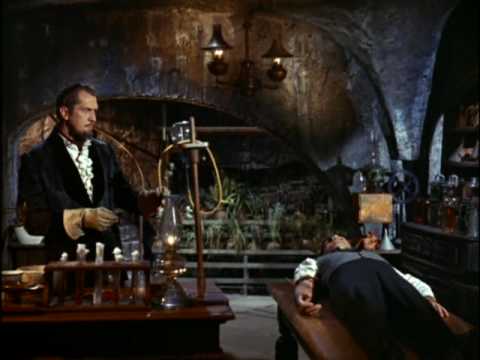
Jack Palance is great in dual role

The Strange Case of Dr. Jekyll and Mr. Hyde (1968)
Starring: Jack Palance, Denholm Elliott, Leo Genn, Billie Whitelaw, Oskar Homolka, Gillie Fenwick, and Jeanette Landis
Director: Charles Jarrott
Rating: Nine of Ten Stars

After the scientific establishment laughs at his theories that he can eliminate man's baser instincts with a medical treatment, Dr. Jykell (Palance) tests his concoction on himself and is transformed body and mind into the vicious Mr. Hyde (also Palance).


This 1968 made-for-TV movie is perhaps the best screen adaptation of Robert Louis Stevenson's classic tale. It is more faithful in tone and spirit than actual content--as I suspect a completely faithful adaptation would be a little boring.

That said, this Dan Curtis-produced film is swathed in London fog (via Canadian sound stages) and is drenched with gothic horror atmosphere. It wastes no time in getting going, and within the first 20 minutes, Dr. Jekyll has unleashed Mr. Hyde, and he's racing down the road to personal destruction and murder.

The film is driven more by excellent dialogue than actual action, but what action there is as thrilling as it is chilling... because Jack Palance is at the top of his game in this film.

Palance is absolutely bone-chilling as Mr. Hyde, showing him as every bit the wild and impulsive figure of Victorian repression unleashed... not to mention pure evil; the scenes where he takes on a group of thugs and later when he torments a woman just because he can are some of the most powerful and dark moments Palance ever had on screen. He also, however, manages to invoke a mixture of sympathy, pity, and occasional disgust, in the viewer with his portrayal of Dr. Jykell, an arrogant and foolish man who lets his dark side run wild just because he can. Jykell's ultimate weakness of character is exposed as the film reaches its climax, and Palance builds it up perfectly with his performance.

This is a must-see for fans of gothic horror, Jack Palance, and just well-made films.


Monday, December 26, 2011

It's Price Times Three in 'Twice-Told Tales'

Twice-Told Tales (aka "Nathaniel Hawthorne's Twice-Told Tales" and "Nights of Terror") (1963)
Starring: Vincent Price, Sebastian Cabot, Beverly Garland, Brett Halsey, Joyce Taylor, and Mari Blanchard
Director: Sidney Salkow
Rating: Eight of Ten Stars

"Twice-Told Tales" is a collection of three short films loosely based on stories by Nathaniel Hawthorne. They are a nice mix of melodrama and horror, and, although they unfold somewhat slowly (and those who think a horror movie has to have gore and violence or it not worth seeing will be bored), each tale features some great classical style acting and chilling twist endings that will keep lovers of well-done dramas entertained.

Vincent Price plays the lead in two of the three segments, and he displays clearly why he was a rising leading man in Hollywood until he shifted gears career-wise and became a star of horror films. Although he is the villain in each piece, he carries himself with such an air of melancholy-tinged elegance that one can't but feel a little sympathy for the evil men he portrays.

In film opens with "Dr. Heidegger's Experiment." Here, Price plays the best friend of the title character (played by Sebastian Cabot), a scientist who discovers a literal fountain of youth in the crypt of long-dead woman they both loved. The two friends regain their their youth, and even manage to resurrect their beloved Sylvia (Blanchard). Unfortunately, turning back the hands of time also resurrects dark secrets long buried.


The second story is "Rappaccini's Daughter". In it, Gionvanni (Halsey) falls in love with a mysterious beauty (Taylor) who never leaves the mansion and walled garden she shares with her father, Rappaccini (Price). It soon comes to light that Rappaccini used chemistry to turn his daughter's very touch poisonous to protect her from sin... and when it becomes clear to him that Giovanni and his daughter love each other, he takes steps to ensure they'll be together and faithful to each other forever. This is perhaps the oddest and saddest of the three tales, and while Price's character is definitely a total madman in this story, he still manages to bring a sympathetic quality to Rappaccini in his performance.

Finally, we have a very loose adaptation of Hawthorne's novel "House of Seven Gables" where Gerald Pyncheon (Price) returns to his his ancestral home with his wife Alice (Garland) and awakens a restless spirit and a deadly curse. While the first two stories were tragedies with "mad science" overtones and nifty twist endings , this one is pretty much a standard haunted house story with all the various expected elements used exactly as anticipated. It's not only a fairly bad take on Hawthorne's novel, but it's also the weakest short film here, and it was one that saw me wishing for the credits to start rolling. Still, Price gives a good performance, and there's never anything wrong with watching someone as lovely as Beverly Garland, even if she is in some nicely put-together dreck. (Oh... and the model shot of the house of the title is probably one of the worst bit of special effects since the Alpine village in Hitchcock's "The Lady Vanishes.")

Although it ends on a down-note, "Twice-Told Tales" is an interesting anthology film. It's a film I recommend highly to fans of Vincent Price, particularly if they've not been exposed to his pre-Corman and pre-Castle days. He is in great form in this film.

Tuesday, December 6, 2011

These 'shrooms provide majorily bad trips

Matango (aka "Attack of the Mushroom People") (1962)
Starring: Akira Kubo, Miki Yashiro, Kumi Mizuno, Hiroshi Koizumi, Hiroshi Tachikawa, Yoshio Tsuchiya, and Kenji Sahara
Director: Ishirô Honda
Rating: Seven of Ten Stars

A sudden storm maroons a group of pleasure-boaters on an uncharted island inhabited by strange mushroom creatures.


If "Gilligan's Island" were a horror movie, then this would be it. We have the Skipper and Little Buddy characters (although they're contemptuous of their passengers and treacherously self-centered as opposed to bumbling and helpful); we have Ginger and Mary-Ann (although one is a shy student and the other a bitchy diva), the Millionaire (the owner of the yacht who is always quick to remind everyone else how rich he is... and the bitchy diva stands in for His Wife), and finally, the Professor (who is, well... the Professor).

"Mantango" is a far more effective horror film than I expected to see from the home of Godzilla and who-knows-how-many-other giant monsters. It stars out feeling like an adventure flick, but once our crew of castaways find the wrecked research vessel on the coast of the island where they are marooned, a sense of claustrophobic horror starts to build. And as desperation starts to grip our band of contentious castaways, it becomes more and more evident that they have nowhere to hide from the monsters or each other.

Perhaps the biggest surprise in the film was that the monsters--the mushroom people--were not as silly as I expected them to be. Perhaps it was because they were tied in with the fact that the only way for the characters to survive was to eat food they knew would turn them into monsters, but the effective make-up effects and costumes also played a role.

While I wasn't thrilled with the "shocking twist ending"--which was so bad that it rivals some of the worst modern offenders I've complained about--everything prior to it as very well done. It's a horror film that's free of gore and nudity, so it can be enjoyed by the entire family. Heck, it's even free of stringy-haired girl-ghosts, so this might just be a Japanese horror flick that even those who are sick of them can enjoy!


Tuesday, November 29, 2011

'Tales of Terror' is Roger Corman at his best

Tales of Terror (aka "Edgar Allan Poe's Tales of Terror") (1962)
Starring: Vincent Price, Peter Lorre, Basil Rathbone, Leona Gage, Maggie Pierce, Joyce Jameson, and Debra Paget
Director: Roger Corman
Rating: Eight of Ten Stars

This is the film that convinced me that Roger Corman actually could make a good movie, when I first saw it. My first exposure to his work was "The Wasp Woman" and "The Terror", not exactly Corman at his best.

"Tales of Terror" is an anthology film that features three shorts loosely adapted from stories by Edgar Allan Poe, and further tied together by the fact that each star Vincent Price in a different role.


First up, we have the chilling and tragic tale "Morella", where a young woman (Pierce) returns to her childhood home in one last attempt to connect with the father who rejected her (Price) after the death of her mother. Moody throughout and downright terrifying at the end, this story is a excellent excursion into the dark corners of the human heart and a fabulous horror story.

Next, we have "The Black Cat", which folds the story of the same name and "A Cask of Amontillado" into one tale of dark comedy as a drunkard (Lorre) ends up in a hum-dinger of a drinking competition with a snooty wine-taster (Price) after he stumbles into an annual wine festival. When he later discovers that wine-taster has been having an affair with his wife, he decides to take drastic action. This tale is characterized by a taut balance between comedy and a brooding sense of dread, with the on-screen interplay between Lorre and Price being a fabulous bit of movie magic. (They're even better here than in "A Comedy of Terrors".)

Finally, we are presented with "The Facts in the Case of M. Valdemar", an exceedingly creepy tale of a greedy mesmerist (Rathbone) who uses hypnosis to trap the spirit of a dying man (Price) between this world and the next... with terrible consequences for everyone involved. This segment isn't as stunning visually as the first two, but it gets plenty skin-crawly as it builds toward its climax.

The ever-present cheapness in a Corman film is invisible here. I've no doubt that every dollar is present on the screen, but the crew working on this film built some great sets, they're beautifully lit, and the camera work and editing is excellent; the material here looks far better than what I still think of as "typical" Corman. Further, there's no obvious padding to dispel the mood of horror and dread in any of the three stories.

All the principal actors (and even some of the bit-players) give excellent performances. I would even venture that Price might not be the best in this film--Lorre's comedic performance is fabulous, as is Rathbone's turn as a blackhearted villain. (That's not to say that Price isn't great in all the three parts he plays.)

If you like classic horror movies, I'm sure you'll love "Tales of Terror." If you tend to sneer at Corman films, as I used to, maybe this one will show that he can be really, really good when working with the right cast, writers, crew... and when he takes more time than 48 hours to shoot a film.


Monday, August 29, 2011

'The House That Screamed' has Hammer Films mood

The House That Screamed (1969)
Starring: Lilli Palmer, Christina Galbo, Mary Maude, Maribel Martin, and John Moulder-Brown
Director: Narciso Ibáñez Serrador
Rating: Six of Ten Stars

The head-mistress of a boarding school for wayward girls (Palmer) tries with increasing fierceness to keep order and discipline in the sea of run-away hormones and rebelliousness among the students and her teenaged son (Moulder-Brown). But soon after the arrival of a new student, someone starts enforcing an even sterner form of discipline in the school's shadow-haunted hallways... a discipline that leaves girls dead.


"The House That Screamed" is a Spanish horror movie that successfully crosses the look and feel of Hammer Films' black-and-white psychological thrillers from the early 1960s with their gothic horror films of the 1960s. Writer/director Serrador isn't quite Terence Fisher, but he's the next best thing, as he delivers an effectively paced, well-staged film that will keep you guessing as to the identity of the killer and what exactly is going on within the walls of the girl's school until the Big Reveal at the end. While the ending ultimately is not all that surprising, the path leading there and its execution is chilling and stylish.

Featuring a talented cast of young actresses as the students, and a superb performance by Lilli Palmer who manages to portray a sadistic, controlling bitch and still illicit sympathy for her from the audience, and some shocking murders, this is a great film to check out if you liked "Susperia" or any of the black-and-white Hammer Films psychological thrillers--even if this film is in color. (Oh, one thing the film is surprisingly short on, what with its all-girls boarding school location, several sexual themes, and even a shower scene, is nudity. I don't recall any, in fact.)


Friday, March 25, 2011

'The Gorgon' is a Hammer Films masterpiece

The Gorgon (1964)
Starring: Peter Cushing, Barbara Shelley, Christopher Lee and Richard Pasco
Director: Terence Fisher
Rating: Nine of Ten Stars

When the spirit of the sole surviving Gorgon sisters of Greek legend rises again to plague a Balkan village, The doctor in a small Balkan village (Cushing) attempts to cover up the fact that citizens are being turned to stone under the full moon, even as a visiting scholar (Lee) attempts to determine the fate of a colleague.


"The Gorgon" is a curious mixture of elements, being part ghost movie, part romance movie, part fantasy epic--but all the elements congeal into a fabulous horror film.

With the usual lush sets that marked Hammer Films of this period, and the usual topnotch direction from Terence Fisher, we have a film that is gorgeous to look at. Add a great script being performed by a fantastic cast, some of whom are in parts we don't typically see them in (Christopher Lee is the monster-busting scholar here, while Peter Cushing is the antagonist who may or may not be in league with the monster) but all of whom are at the top of their game.

"The Gorgan" contains a number of truly chilling moments and the script features a couple of twists and turns, so that the viewer is kept guessing as to who is actually host to the gorgon's spirit until it is revealed. Even better, the final confrontation between the heroes and the Gorgon is one of the most dramatic endings to a Hammer film, period! (The film loses a bit of steam as it heads toward the climax, but the finale more than makes up for the slight drag.)

"The Gorgon" is one of the most underrated horror flicks from Hammer Films. For years it was unavailable even on VHS, but Sony finally released four Columbia-distributed Hammer Films in a multi-movie set as part of their "Icons of Horror" series. Get it. All four films in the set are excellent, with the "The Gorgon" being the very best.


Tuesday, March 22, 2011

'Fangs of the Living Dead' has no bite

Fangs of the Living Dead (1969)
Starring: Anita Ekberg, Julian Ugarte, John Hamilton, Diana Lorys, Adriana Ambesi, and Guy Roberts
Director: Amando de Ossorio
Rating: Three of Ten Stars

A model (Ekberg) is summoned to her ancestral home to receive her inheritance. She comes under the influence of her sinister uncle (Ugarte) and the cult of vampires that is forming around him.


"Fangs of the Living Dead" plays like a lobotomized version of "Dracula", with several scenes heavily inspired by the novel and with Ekberg's Sylvia standing in for Jonathan Harker, crossed with a "dark old house" movie and flavored with the graphic sensibilities and tight dresses of 1960s Hammer gothic horror flicks. If the filmmakers had stuck with this approach, the over-the-top acting, the melodramatic dialogue, and the dippy characters would all add up, whether intentional or not, to a hilarious send-up of the gothic horror genre. The overblown soundtrack music only makes it all the more funny. Unfortunately, it's all ruined when writer/director Amando de Ossorio tries his hand at a twist ending that tries to undo everything that unfolded in the film and reduces what was funny to a level of idiocy. And the twist on the twist doesn't help any. In fact, these are such misguided twists that one wonders if everyone involved with the production has severe memory issues, as it doesn't fit with much of what unfolded earlier. (That said, the "twist" itself could be a misfired attempt at spoofing horror movies, which would mean the movie was intended as a send-up all along; in the 1930s and 1940s, it wasn't uncommon for the supposed supernatural elements in a film to be written off through a revelation in the third act that it was all a hoax. The most blatant example of this can be found in "Mark of the Vampire".)

The film is further crippled by the fact that headliner Anita Ekberg is miscast. At 38, she was a bit long in the tooth to play the part of the "naive young heiress" and as a result she comes across more like a blonde so dumb that calling her retarded would be a compliment.

However, for all its weaknesses, the film features some nice cinematography, and the director manages to evoke a chilling atmosphere here and there, especially during the sequence when Ekberg is running around the castle in terror, and the one that riffs on the "Dracula" scene where the heroes wait for the undead Lucy in the graveyard. The drunken village doctor who stands in for the Abraham Van Helsing character is also a great deal of fun... and then there's the vamp-on-vamp battle to the death during the film's climax, one of the great cat-fights in cinematic history.

In the end, though, the bad far outweighs the good. The film rates the lowest possible Three I can give it, and it is only suitable for viewing as part of a Bad Movie Night.


Friday, March 18, 2011

Hammer unmasks the 'Phantom of the Opera'

The Phantom of the Opera (1962)
Starring: Edward DeSouza, Heather Sears, Herbert Lom, Thorley Walters, and Michael Gough
Director: Terence Fisher
Rating: Eight of Ten Stars

As if Harry (DeSouza), a young director and producer of operas, didn't have enough problems dealing with the massive ego of the creator and backer of his latest show (Gough), and the backer's unsavory designs upon the young, virginal diva (Sears), the production is plagued with mysterious disasters. Harry soon uncover darks secrets surrounding the production, but will he manage to placate the Phantom of the Opera (Lom) before it is too late for all involved?!


The Hammer version of "The Phantom of the Opera" is the fastest moving, most-visually interesting adaptation of the tale that I've seen. The watery lair of the Phantom is very cool, Heather Sears is a hotty and she also plays nicely off Lom, and Michael Gough is the perfect upper-class slime and wanna-be musical genius who only acheives that status when he steals the life-work of another man. All in all, the cast here is great, and it's another Terrence Fisher-helmed movie that's absolutely gorgeous to behold.


Thursday, November 25, 2010

'The Reptile' is Hammer at its most gothic

The Reptile (1966)
Starring: David Baron, Jennifer Daniel, Noel Williams, Jacqueline Pearce, and Michael Ripper
Director: John Gilling
Rating: Seven of Ten Stars

A retired military officer and his wife (Baron and Daniel) inherit a cottage in a small Cornish village after his brother dies under mysterious circumstances. When he moves there with his wife (Daniel), he discovers that there has been a rash of deaths and that all of them can be attributed to a rare poisonous animal found only in far-away India. The obvious perpetrator behind these dastardly deeds is the reclusive doctor of theology (Williams) who has made a career out of studying obscure religions in the Far East and who keeps his daughter a virtual prisoner in their manor house. But throw in a mysterious swarthy fellow, the daughter’s strangely hypnotic effect on her father when she plays the sitar, and things are a little less clear. Will the newly arrived couple’s only ally in the area (Ripper) help them stop the spreading evil before it consumes them all?


“The Reptile” is the most strongly gothic-in-genre of all the Hammer horror flicks. There’s the ogre-like father and the oppressed daughter; there’s the mysterious Outsiders who are bringing a corrupting influence to wholesome British society, and there are curses and victims and victimizers who may not be what they seem. It’s a well-mounted film that contains several moments of genuine chills.

“The Reptile” would have gotten an 8-Star rating if not for the inexplicable over-acting displayed by all the principles in the first half of the movie; inexplicable because the leads in the film director John Gilling helmed immediately prior to this one (“Plague of the Zombies", which even used many of the same sets) was blessed with beautifully restrained performances that made the film even creepier and more believable. It’s even odder because Michael Ripper gives the same type of understated performance he did in “Plague.”)

As the film evolves, the over-blown performances start to fit with the tenor of the going-ons, but they seem so out of place early in the film that it’s an irritant. The movie’s resolution is also a bit weak, with the title creature going down without much of a fight. The combination of the overacting in the first reel and the shaky climax were enough to knock off a Star. Still, it’s an entertaining film if you enjoy Hammer-style movies or gothic tales.


Tuesday, November 23, 2010

Happy Birthday, Mr. Karloff

In celebration of Boris Karloff's birthday, I present a review of one of last great screen appearances. For more reviews of films featuring this great actor, visit The Boris Karloff Collection.

Targets (1968)
Starring: Boris Karloff, Tim O'Kelly, Nancy Hsueh and Peter Bogdanovich
Director: Peter Bogdanovich
Rating: Eight of Ten Stars

As aging horror movie star Byron Orlok (Karloff) prepares to announce his retirement, a seemingly average young man, Bobby (O'Kelly), embarks on a killing spree. The creator of make-believe monsters and the real-life monster come face to face when Bobby's day of terror culminates with a sniper rampage at the drive-in where Orlok is making his final public appearance.


In "Targets", Bogdanovich expertly interweaves two storylines that only really connect in a single scene at the film's climax. In the process, he manages to build a tremendous amount of tension, because we come to like and care about Orlock, his secretary (Hsueh), and the young writer/director (Bogdanovich) who is trying to convince him to make at least one last movie--his movie. The audience can see that these three characters are going to walk head-long into Bobby's gun-sights, and Bogdanovich establishes that he is a good shot.

Although the entire film is perfectly paced, well-acted--with Karloff in particular shining, despite his health being poor at the time--and looks far better than the shoe-string budget it was shot on should allow, it's the scene where the two stories finally completely merge, with Orlok and Bobby confronting each other that really makes the movie for me.

This is a film that's definately worth seeing for fans for suspense and horror movies and admirers of Boris Karloff. It's the last good movie in Karloff's career and like so many of his films it holds up spectacularly well.

As I make this post, "Targets" is officially unavailable commercially. A few copies may still be had at retailers and you want to make sure you get the "Paramount Widescreen Collection" DVD version of the film. That disc includes an interview with Bogdanovich. It gives some fascinating insights into how the movie came to be. It's a very different film than it started out as--a throw-away Roger Corman production made to fulfill Karloff's contractual obligations to the producer--and it's a story that illustrates that pure business decisions can sometimes lead to great art, even on shoe-string budgets and tight shooting schedules.


Tuesday, October 19, 2010

The film that reshaped pop culture zombies

Night of the Living Dead (1968)
Starring: Judith O'Dea, Duane Jones, Karl Hardman, Marilyn Eastman, Keith Wayne, Judith Reilly, and Kyra Schon
Director: George Romero
Rating: Eight of Ten Stars

When the dead rise to eat the living, a small group of people board themselves up in a house and attempt to hold out against an army of hungry zombies.


"Night of the Living Dead" is perhaps one of the most effective horror movies ever made. While its budget constraints are occassionally evident, and the acting leaves something to be desired at times, it still emerges as one of the scariest, most intense, films ever, with near-perfect pacing, great camera work, and sparse but effective set design and special effects. It's also arguably the most influential film of modern times, and many creators of horror and suspense films from the past 20 years probably owe quite a bit to Romero for inspiriation.

The key to the films success is that it incorporates a bit of the morality play aspect that exists at the core of most horror movies with a complete sense of claustrophobia and a certain doom. Although a national (possibly worldwide) disaster in unfolding, the action of movie is mostly confined to a single house, and the threats that those barricaded within come not only from the undead hoard outside, but also from each other as their various character flaws are explosed and amplified due to their situation. (Of course, it also features one of the most disturbing zombie flesh-eating scenes that have ever been put on fillm... if you've seen the film, you know what I mean, and if you haven't yet, you will know as soon as the moment happens.)

Despite recognizing this as a true classic fillm, I also admit it's not perfect. In addition to the acting, there's a couple of plot holes. I recently watched the movie again, and I still find the opening cemetary sequence strange beyond words, and I still am not certain what Barbara's ultimate fate is. (One thing I am certain of is that it's not a racist movie. I watched the film again, because I heard how it was supposed to have racist undertones throughout--undertones that are fully exposed at the film's climax--and since I'd never noticed that, I figured I'd watch the film again. Well, I'm here to tell you that anyone who finds racism in this movie is probably a racist themselves who are engaging in a bit of projection.)

This film is one of the most commonly found in the massive DVD multipacks, and it is a highlight of every package it's in; it plus one or two additional movies you're interested in will make the set worth its purchase price.

If you haven't seen this classic and are a fan of zombie movies and horror movies in general, this is a must-see. It's the original of the "modern zombie" and a damn fine movie to boot. The above is even more imperative if you're a filmmaker making low-budget pictures. THIS is what the low- and "micro-budget" movies should be like... completely free of padding and waste.

Wednesday, October 6, 2010

Madness goeth before fall in the House of Usher

The Fall of the House of Usher (aka "House of Usher") (1960)
Starring: Mark Damon, Vincent Price, Myrna Fahey and Harry Ellerby
Director: Roger Corman
Rating: Eight of Ten Stars

When Philip Winthrop (Damon) travels to an remote estate with the intent of bringing his fiancee Madeleine Usher (Fahey) back with him to Boston so they can be married, he learns from her brother Roderick (Price) that she and he both suffer from a degenerative disease that will eventually kill them. But things are not quite what they seem, and Withrop will come face to face with many horrors as he witnesses the fall of the House of Usher.


"The Fall of the House of Usher" was the first in a string of Edgar Allan Poe adaption from producer/director Roger Corman, many of which captured the spirit of Poe's tales but few of which were faithful to their source material. This one is not only fairly close to the original story, but it is quite possibly the best film that Roger Corman ever helmed.

Almost every director produces a masterpiece. This film may well have been Roger Corman's.

Not only is Corman at his best, but I don't think Vincent Price has ever been more successful at portraying a vile, quietly insane character as he does with Roderick Usher. Mark Damon provides a great foil as the handsome, heroic suitor, and, although her role is mostly that of a gorgeous damsel in distress--at least until the film's terrifying conclusion, Myrna Fahey's performance is of a caliber that makes it clear that her death from cancer at the age of 40 was a real loss to the art of movie making.

Featuring excellent pacing with a mounting tension that results in the final 30 minutes of the film being some of the most intense and scary horror footage ever recorded, great acting with just enough melodramatic touches to add a touch of gothic romance to the film's horror- and madness-soaked atmosphere.

If you're looking for a movie that will scare the heck out of you without resorting to gore and graphic violence, then you need look no further than this movie. The nearly fifty years that has passed since it was made has done nothing to dull its impact. It may be a little slow-building to be suitable Halloween party viewing, but it's a film that should be seen by anyone who appreciates well-done horror movies... and it's a must-see if you're a fan of the sort of gothic horror that was embodied in the Hammer films from the 1950s and 1960s, or in the Ravenloft dark fantasy world.

Thursday, July 29, 2010

'The Terror' is borderline terrible

The Terror (aka "Lady of Shadows", "The Castle of Terror", and "The Haunting") (1964)
Starring: Jack Nicholson, Sandra Knight, and Boris Karloff
Director: Roger Corman
Rating: Four of Ten Stars

A French officer (Nicholson) during Napoleon's campaigns encounters a mysteriously alluring woman, Helene (Knight). Everyone denies she exists, but when he tracks her to the isolated, crumbling castle of Baron Von Lepp (Karloff), he discovers the girl may be ghost.


"The Terror" is basically pretty awful, and it shows every sign of having been made up as filming took place--the number of times where a character/actor seems completely oblivious to what he supposedly just experienced in the previous scenes far outnumber the times when there's continuity between scenes--it takes forever to get going, the dialogue is awful and repetitive, and the film can't seem to make up its mind what the nature of Helene is. (This waffling goes far beyond the filmmakers wanting to keep the audience guessing.) However, there's enough here that if you enjoy classic horror flicks, you'll keep watching.

Unfortunately, just as the movie starts getting good, the filmmakers throw in what is perhaps the dumbest and most pointless "twist" to ever be committed to film. It is so lame that it almost cost the film an entire Tomato in my rating. (It earned it back, however, with the very startling final scene.)

"The Terror" is better than many Roger Corman movies, but not as good as the Edgar Allen Poe films that it uses stock footage and sets from. If you're a lover of Amicus, AIP, and Hammer Films from the 50s and 60s, I think you might find something worthwhile here, but otherwise, I recommend you take a pass. (For the record, I was torn between giving it 4 or 5 Stars... it teeters on the brink between those two.

"The Terror" is available on DVD from a number of different distributors, but I think it's only worth getting if it's part of a multi-movie set. Unfortunately, virtually every copy of the film I've come across has been lacking the one element that might have lifted the viewing experience a bit--the vibrant colors of the original set and costume designs. All the DVD copies available seem to have been made from faded and worn prints. (For a look at what "The Terror" could look like, we have to turn to "Targets," as the clips from the movie-within-the-movie are actually scenes from "The Terror.")


Saturday, May 22, 2010

You just can't keep a bad vampire down....

Dracula Has Risen From the Grave (1968)
Starring: Rupert Davies, Veronica Carlson, Christopher Lee, Ewan Hooper, and Barry Andrews
Director: Freddie Francis
Rating: Six of Ten Stars

After a craven, cowardly priest (Hooper) accidentally revives Dracula (Lee) from an icy grave in a shadowy crevice of a Transylvanian mountain, the vampire lord discovers his castle has been sealed with blessings and cruxifixes. Swearing revenge, he pursues the Monsignor who made his home inaccessible to him (Davies).


Although it's a direct sequel to "Dracula: Prince of Darkness", "Dracula Has Risen From the Grave" pays little attention to continuity. (Castle Dracula is a fortress in this movie, where it was more of a chateau in the two previous films.)

That aside, however, the film presents a Dracula who is far more evil than he's been portrayed before, cramming more nasty needs into the limited amount of time he is afforded into the story into this one movie than in the previous two. The opening of the film where a murdered girl is found stuffed inside a church's bell is one of the more shocking openers to any of Hammer's horror films. Dracula's pursuit of Monsignor Mueller and his family--particularly of the lovely Maria (Veronica Carlson) also gives rise to a number of chilling moments.

The movie also features some fine acting, gorgeous sets and great camerawork... not to mention the gorgeous cleavages of Carlson and Barbara Ewing! In other words, it's got all the elements we expect to find in a Hammer vampire flick from the 1950s and 1960s.

Unfortunately, the film suffers from the lack of a strong antagonist to combat Dracula. Rupert Davies is okay, but he's no Peter Cushing (Van Helsing in "Horror of Dracula") or Andrew Keir (Father Sandor in "Dracula: Prince of Darkness"). It also doesn't help the film that the good guys triumph in the end here because of a deus ex machina finale. (And I think that plot device has rarely been so literally on display as it is in this film.)

If you're a fan of Hammer's vampire movies, I think you'll enjoy "Dracula Has Risen From the Grave". It's not quite as good as "Horror of Dracula" or "Dracula: Prince of Darkness", but it's a nice chiller.


Wednesday, May 5, 2010

Happy Cinco de Mayo!

Although, honestly, it might be a happier day all around if you don't celebrate by watching the movie in today's review. (Even if it is a Mexican production.)


The Isle of the Snake People (aka "The Snake People" and "Island of the Dead") (1968)
Starring: Ralph Bertrand, Charles East, Boris Karloff, Julissa, Santanon and Tongolele
Directors: Juan Ibenez and Jack Hill
Rating: Three of Ten Stars

When a new police captain (Bertrand) arives on a small Carribean island, he vows to clean up police corruption and to break up the local voodoo cult. The cult, which is on the verge of ushering in a new age where their dark gods will rule supreme, go on the warpath against him. Can one honest cop defeat a cult specializing in zombie sluts and led by a crazed, tophat-wearing dwarf (Santanon), a voodoo priestess--or maybe just an exotic dancer in a really cool outfit who got lost on her way to a gig--(Tongolele) and a mysterious masked man (who can't possibly be the wealthy, eccentric plantation owner Van Molder (Karloff))?


"The Isle of the Snake People" is to Karloff films that "Bride of the Monster" is to Lugosi movies. Both films were made at the very end of long careers, and both films saw that those careers ended on very low notes. (This film is one of three that Karloff made in his final year, all Mexican productions that were made for distribution in movie theaters that catered to Spanish-speaking audiences in the United States. They were later dubbed into English. Karloff's scenes were shot on sets in Los Angeles while the bulk of the films were made in Mexico.)

This movie is boring to the point where you must have a book to read, or someone to make out with, while watching if you are to have any hope of getting through it. There are some scenes that could have been disturbing if they didn't go on forever--like the opening vooodoo ritual with that creepy dwarf--but the only truly creepy scenes are limited to those featuring flesh-eating zombie women. Mostly, the film just trudges along, from badly filmed scene to a badly acted one, and onward into infinity. (Actually, if one took a hatchet to this film, cut it down to maybe 40 minutes in length and retitled it "Night of the Flesh-Eating Zombie Sluts", it might end up as entertaining. It might even end up coherent.)

Boris Karloff is the only good thing about this film. The scantily clad belly-dancing voodoo priestess might have been a plus as well... if she'd had a bag over her head. She's got one of those "I've been in the sex industry entierly too long" hard faces and it sort of ruins the fantasty aspect. But Karloff, like Lugosi in "Bride of the Monster" gives his part his all, and watching him--even if he seems old and tired--is as much fun as always. (His interplay with his puritanical neice (Julissa) who has come to the island to save the natives from the evils of alcohol shows he had magic up to the very end.

If you're a Karloff fan, pretend "Targets" was his last film and that "Isle of the Snake People" doesn't exist. You won't be missing anything... except a freaky dwarf and a belly-dancer that should have been wearing the mask instead of the cult leader.

If you're a completist who feels you must see and/or own every Karloff movie, I can't recommend that you get any of the stand-alone versions of this film. If you must have it, pick up one of the DVD multi-packs it's included in to get value for your money. (There's a particularly good one that includes "Night of the Living Dead" and two other films.)


For more reviews of Boris Karloff movies, click here to visit the companion blog The Boris Karloff Collection.

Thursday, March 11, 2010

Christopher Lee vs. the Devil Cult

The Devil Rides Out (aka "The Devil's Bride") (1967)
Starring: Christopher Lee, Charles Gray, Nike Arrighi, Leon Greene, and Patrick Mower
Director: Terence Fisher
Rating: Eight of Ten Stars

Gentleman adventurers the Duke of Richleau (Lee) and his friend Rex Van Ryn (Greene) discover their young friend Simon Aaron (Mower) has fallen in with a Satanic cult masquerading as an astrological society. They stage a rather heavy-handed intervention, ultimately carrying off Simon and a young woman named Tanith (Arrighi). Turns out, Tanith has been chosen to be the consort of a demonic entity--the Goat of Mendes--and soon nefarious cult leader Mocata (Gray) is turning the full force of his supernatural powers on the Duke and his friends.


Although ostensibly a horror movie, "The Devil Rides Out" also has the flavor of the old fashioned action serials like "Bulldog Drummond." The Duke and his friend Rex, for all the Duke's expertise with the supernatural, are a pair of dashing, classic adventurers, and the tone of the film is more akin to one of those classic adventure tales, with a heavy dose of the supernatural via Mocata's Satanic cult thrown in.

Speaking of Mocata, Charles Gray has never been as sinister as he is here. Not only is he performing at the top of his game, but the character's ability to remote-control his followers gives rise to some of the film's most suspenseful moments.

Christopher Lee also gives one of the best performances of his career in this film. Not only is he at his most commanding and heroic, but, unlike so many other movies he appeared in, the director takes full advantage of Lee's ability to dominate a scene. The Duke of Richleau as portrayed by Lee is every bit the impressive figure the story makes him out to be. And the battle of occult skill, will, and personality that he engages in with Mocata is believable--and satisfactory in its resolution--because of the way Lee's presence shines in the film.

In fact, this is another film where director Terence Fisher pretty much has every actor, every set element, and every special effect and film edit, working at the best possible level. He had a gift for making these low-budget Hammer Film releases look like they were made for ten times what they cost.

"The Devil Rides Out" may not be a Hammer Films release that gets a lot of attention, but it's definitely one of the best films that the company produced. The mix of horror and adventure, along with some rather clever plot-twists as the story unfolds, keeps the viewer engaged from beginning to end.

Tuesday, January 26, 2010

A film Roman Polanski would love?

Tormented (1960)
Starring: Richard Carlson, Susan Gordon, Lugene Sanders, and Juli Reding
Director: Bert I. Gordon
Rating: Four of Ten Stars

Tom Stewart (Carlson), a third-rate ladies' man, lands himself a beautiful girl with more money than brains (Sanders) and is about to tie the knot> However, he first has to dispose of his former girlfriend, Vi (Jeding). Unfortunately for Tom, he failed to realize that hell hath no fury like a woman scorned, whether she's alive or dead... and he soon finds himself haunted by Vi's floating head and other random detached body parts.


The "hero" of this film is perhaps the singularly most unlikable character I've ever been expected to feel sympathy for in a movie. Not only is Tom rotten to the core, but I get this child-molester vibe off him whenever he's around his fiance's little sister. (Of course, part of that is because he thinks she may know that he killed Vi and he's working hard to gain her trust, and eventually he tries to do the ultimate slimeball thing and kill the little kid, but there's still that vibe...)

The greatest problem with this film, and it's only partially because of its low budget, is the way things that are supposed to be scary--like when Vi's ghost manifests--are laughable. The overall flatness of the acting is also a crippling factor. Carlson does a good job as the ultimate scumbag, and little Susan Gordon gives a surprisingly good performance for a child actor... particularly when one considers that she probably got the part first and foremost by being the director's daughter.

The film does have some interesting visual flourishes, and there are several suspenseful scenes that take place in an old lighthouse. In fact, all the movies suspenseful scenes take place in the old lighthouse; whenever we get away from that location, things tend to drag a bit--except when Carlson is giving off "dirty old man" vibes around Gordon. The horror is strong at that point, whether the setting is the lighthouse or not.

The basic idea of this film--which crosses a film noir sort of attitude with a ghost story--is one that appeals to me. The execution here is sorely lacking, however.


Someone should ask Roman Polanski if he has seen this flick. I'm sure he'd have all kinds of sympathy for Tom if he did. He might even want to option a remake and relive the excitement of his youth by having Tom feed Sandy roofies and then rape her before deciding she knows too much and must die.

Wednesday, January 20, 2010

Happy Birthday, Mr. Poe! (Belated)

I tried to schedule posts to go up automatically... and I screwed up.

In celebration of Jan. 19, the birthday of Edgar Allan Poe, here's a review of one of the best movies based on his writings.

Masque of the Red Death (1964)
Starring: Vincent Price, Hazel Court, Jane Asher, Patrick Magee, and David Weston
Director: Roger Corman
Rating: Eight of Ten Stars


As a plague known as the Red Death sweeps across the countryside, Prince Prospero (Price) believes the walls of his castle and his devotion to Satan will keep him and his foul friends safe. But one evil act too many brings a mysterious guest to a masquerade ball the prince throws.

This is the only Roger Corman film I've seen so far that I felt I could give a glowing review without tacking on ANY qualifications. "Masque of the Red Death" is a fine horror film that engages both the mind and the gut as it unfolds. It is proficiently acted, well-scripted and perfectly paced, expertly filmed within amazing sets... everything here is clicking. What's more, the film evokes its horror and dread through a well-told story rather than gore and other special effects. If there ever was a Corman film that should be described as "great" and that is worth seeing by fans of good movies (not just cheesy ones), then this is it.

Vicent Price is in top form as the evil prince, and Hazel Court also shines brightly. It's obvious that some of Corman's very best work was done while filming under the umbrella of a taxshelter in Great Britain, and "Masque of the Red Death" is the best of that work.


Click Here to read the original story this movie was based on, as well as other great works by Edgar Allan Poe.

Tuesday, January 12, 2010

When low budgets attack....

Sting of Death (1966)
Starring: Joe Morrison, John Vella, Valerie Hawkins and Jack Nagle
Director: William Grefe
Rating: Four of Ten Stars

After being ridiculed for his theories and tormented by a bunch of partying college kids, a marine biologist's assistant, Egon (Vella) transforms himself into a human jellyfish monster and goes on a murderous rampage. Will Beauty (Hawkins) conquer the Beast yet again, or will she die screaming in pain from his poisonous jellyfish touch?

"Sting of Death' is one of those movies that has a decent script at its core, but just about everything else about it is otherwise awful.

The actors featured are uniformly bad--with only John Vella, as the assistant who steps into the role as a mad scientist, and Valerie Hawkins, as the ever-screaming love interest, showing even the slightest bit of talent. Although that might be a bit unfair to the actors. The awful, stagy way they deliver their lines, with everyone politely waiting for lines to be completely finished before delivering their own, even when they are supposed to be interrupting and talking over another character, has also got to be the fault of the director to some degree.)

The special effects are almost as awful, with the film's giant jellyfish appearing like plastic bags with a little coloring in them, and the half-man, half-jellyfish monster looking like a guy in a bodysuit with an inflated garbage bag over his head. When we just saw its hands and stinging tentacles, it was creepy but the "big reveal" at the end made it just seem pathetic.

This is a film that clearly demonstrates that if you don't have the budget for decent costumes and effects, you really, REALLY need to make up for it by keeping your monster unseen or by camouflaging it with clever lighting and camera angles.


When the Jellyfish Man is scary...


... and when he is not, in two scenes from "Sting of Death"


"Sting of Death" would rate a 3 if not for a handful of very well-executed scenes. There's an attack by the jellyfish man that put me in mind of "Jaws" it was so well done, followed by a very creepy credits sequence. Later, an attack by monstrous jellyfish on the passengers of a sinking boat reminded me of the disabled catamarans in "Jaws 2". Then, there is an attack scene on land that someone should license for an anti-smoking commercial.

With the exception of the final battle between the jellyfish man and dashing young Dr. John (Joe Morrison), all the monster scenes in the film are very well done... better in fact that is the norm for the sort of no-budget school of filmmaking represented here. Combined with some nice cinematography, "Sting of Death" ends up being just entertaining enough to hold your attention as it unfolds, despite the bad actiing and the padding with dance party sequences (where the same footage of shaking booties gets used again and again).


The second feature on this DVD is reviewed at the companion blog "Movies to Die Before Seeing." You can read about it by clicking here.

Sunday, January 10, 2010

Bava delivers stylish tale of gothic hauntings

Kill, Baby... Kill!
(aka "Curse of the Dead", "Don't Walk in the Park", and "Operation Fear") (1966)

Starring: Giacomo Rossi-Stuart, Erika Blanc, Fabienne Dalin, and Max Lawrence, Valeria Valeri, and Giana Vivaldi
Director: Mario Bava
Steve's Rating: Six of Ten Stars

Dr. Paul Eswai (Rossi-Stuart) arrives to assist with a murder investigation in a remote village. He finds the place gripped in fear of some evil whose name they don't even dare to mention. Although he at first dismisses it as superstitious nonsense, Paul finds it increasingly difficult to deny that the town is being haunted by the ghost of a vengeful little girl (Valeri)... particularly after he and a young woman with a mysterious past (Blanc) become targets of the spirit's wrath. Will he discover the secret behind the hauntings before it's too late to save himself?


"Kill, Baby... Kill!" is an Italian production that has all the production values and moodiness of some of the best Hammer gothic horror films from the late 1950s and early 1960s. If it wasn't for the bizarre color schemes that director and cinematographer Mario Bava likes to use to light his sets--lots of reds and greens, even in outdoor night shots-- and a somewhat more ponderous pace throughout, one might mistake this film as coming from the hands of the likes of Terence Fisher.

The film has a decent cast, an engaging, convoluted story that keeps twisting and turning up to nearly the very last moment of the film, and a very creepy little girl ghost. (Yes, the stringy-haired Japanese ghost chicks weren't the first underage phantoms in skirts to massacre the fearful.)

On the downside, the film suffers from a pace that never quite gets to where it should be. Bava treats us to some great visuals but he goes overboard with them and they become drags on the film at several different times than mood setters... there's just a little too much calling attention to the tricks of the trade than simply applying them. (And here's where Fisher leaves Bava in the dust... he made gorgeous, moody pictures, but he never felt the need to call the audience's attention to his work... instead, we just absorbed the whole.)

Aside from Bava's cries for attention throughout the movie, the end also suffers from a touch of "deux ex machina". It's an ending that makes sense and which is well-founded in the events of the film, but I would have liked the hero and heroine to have been just a little more directly involved in the resolution. I can see the rationale for why they weren't--the fact that the village sorceress (Dalin) is ultimately the one who stops the ghost plays into the conflict between science and superstition that is part of the movie's core. However, I think the ending would have worked better if science and sorcery came together to resolve the curse that gripped the town.

(And, frankly, given the way the sorceress deals with the root of the problem, even Erika Blank's damsel-in-distress character could have played a part.)

Although flawed, "Kill, Baby... Kill!" is a decent ghost movie. Fans of European horror films from the '60s and '70s should enjoy it. Heck, the fans of stringy-haired Japanese ghost girls will find quite a bit to like in this film, too.